

 Follow us on LinkedIn
The moment everything changes
I often ask people to close their eyes and picture their work life:
- I ask them to think about their boss, the people they work with every day, their goals, their priorities, and the way they get things done.
- I ask them to picture their customers, whether those are internal stakeholders or external clients.
- I ask them to think about the moments they are proud of, the moments where they felt connected to the company and the work they do.
Then I ask them to imagine being called into an office and hearing the news that the company is being acquired.
Not only that, but the company doing the acquiring has already purchased several firms in the industry, and it is backed by private equity.
When people open their eyes, the reactions are always fascinating.
Some people are excited because they have worked toward an exit strategy. Others immediately feel uncertainty or fear. Some have lived through acquisitions that ended badly. Others have experienced mergers that completely disrupted their workplace culture, relationships, and sense of stability.
Those feelings are real.
There is a reason people react so emotionally to mergers and acquisitions. We have all seen the headlines. We have all heard the stories about layoffs, broken cultures, talent loss, and integrations that failed because organizations never figured out how to truly come together.
The statistics around mergers and acquisitions are not exactly encouraging either. Culture challenges are one of the biggest reasons integrations struggle.
Talent loss after acquisitions is common. Entire organizations can spend years recovering from poorly managed transitions.
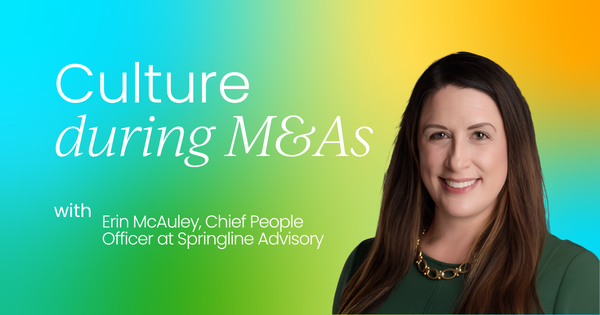
So when we started building Springline Advisory, we knew culture could not be an afterthought.
We wanted it to be our differentiator.
Not in a superficial way. Not as a slogan printed on a wall or written into a recruiting brochure. We wanted culture to become part of our operating model.
We wanted it to shape how we worked, how we grew, how we chose partners, and how we showed up for each other.
We called that philosophy “scaling with soul.”
 Teresa Garanhel
Why culture became our strategy
Springline is one of the fastest-growing accounting and advisory firms in the country, even if we are still a name some people are just beginning to hear.
From the beginning, we approached growth differently.
We did not want to become a massive organization that lost the personal relationships that make great firms work. We wanted to build what we called a “big small firm.”
That idea mattered deeply to us.
We wanted the reach, capability, and opportunity that come with scale, but we also wanted to preserve the closeness, care, and relationships that make smaller firms special.
In accounting and advisory work, relationships are everything. Many people keep their accountants longer than they keep a doctor or, in some cases, even a significant other.
These are incredibly long-term relationships built on trust.
That means culture is not just an internal issue. It directly affects clients, employees, and business outcomes.
When organizations ignore culture during acquisitions, people feel it immediately. Employees feel disconnected. Leaders lose credibility. Clients sense instability. Teams stop collaborating.
We saw culture as business strategy because, for us, it truly is.
Starting with a philosophy instead of prewritten values
One of the most important decisions we made early on was that we were not going to impose a set of corporate values on the firms joining Springline.
We did not start with a prewritten list.
Instead, we started with our philosophy of scaling with soul and then invited our founding firms to help us create the values together.
That mattered because we were not looking to absorb firms and erase what made them successful. We wanted to build something collectively.
In fact, we often avoid using the word “acquired.” We talk about firms becoming founding firms because we wanted people to feel like builders and coauthors.
The firms joining Springline were already exceptional organizations. They were winning workplace awards in places like Indiana and Kansas City. They had strong client relationships, thriving businesses, and respected leadership teams.
So we asked ourselves a simple question: Why would we ignore the wisdom and culture they had already built?
Instead, we partnered with Barrett Values Centre to better understand who we collectively were.
We asked people foundational questions about:
- Their personal values.
- The current values of their firms.
- What values they hoped their organizations would embody in the future.
- What was working well and what was not.
- And then we introduced the idea of scaling with soul and asked what that philosophy meant to them.
I remember feeling both excited and nervous about what we might discover. Whenever you ask people to speak honestly about culture, there is always uncertainty about what will come back.
What surprised me most was how aligned people already were.
Across firms, geographies, and teams, people shared remarkably similar personal values.
That alignment mattered because we are fundamentally a relationship business. If people do not share values, it becomes very difficult to build lasting partnerships.
When you are sitting across from a business partner, a client, or a colleague, you want confidence that you are aligned in how you approach integrity, trust, and relationships.
The data showed us we had a strong foundation.
The firms joining Springline were already healthy organizations with strong cultures. We scored well above benchmark averages in organizational health.
But the process also gave us something even more important.
It gave people ownership.
Teresa Garanhel
Co-creating values together
After gathering the data, we started refining and testing what our shared values actually looked like.
This was where the process became deeply collaborative.
We reviewed themes, reshaped ideas, and continuously checked back with employees to ask whether the emerging values genuinely reflected who they were.
And honestly, one of my favorite parts of the process was seeing how engaged people became.
Accountants and auditors are not always the first audience people imagine when they think about culture workshops. But what amazed me was how thoughtful, practical, and invested people were in getting this right.
The values that emerged reflected how we wanted to grow together.
Growth became one of our shared values because growth is not just about revenue or scale. It is about helping clients grow, helping employees grow, and helping the organization evolve.
Groundedness became another important value because integrity matters enormously in our profession. We wanted to stay grounded in relationships, grounded in trust, and grounded in the responsibility clients place in us.
At the same time, we knew we could not operate exactly as we had when firms were smaller.
The industry itself is changing rapidly.
Artificial intelligence is transforming workflows. Talent shortages are reshaping recruiting and retention. Global collaboration and offshoring are changing how work gets done.
We needed to reimagine what the future of the profession could look like.
That required people to take ownership.
Many accounting firms are built on partnership models where leaders know each other deeply before entering into business together. People are literally putting their compensation, reputation, and careers into shared partnership.
We wanted people to come into Springline wholeheartedly.
We wanted them to feel fully invested in building this future with us.
Turning values into action
Once we had co-created our values, we knew the next step was turning them into something real.
Values cannot just live on slides or posters.
So we launched what we called “Let’s Grow” workshops.
These sessions brought employees together across firms and geographies to talk openly about what we collectively needed to start doing, stop doing, and continue doing.
The conversations were incredibly powerful.
People consistently said they were surprised by how authentic the discussions felt. They did not feel like corporate exercises or abstract statements. Employees saw themselves reflected in the values.
They also discovered how much they had in common with people they had never met before.
Someone in Indiana would connect deeply with someone in Seattle or Florida. People realized they shared similar priorities, similar values, and similar visions for what a great firm could become.
That process created excitement.
It shifted the integration experience from something being done to people into something being built with people.
And that distinction matters enormously.
Too often, acquisitions create a feeling that one organization is swallowing another. Employees feel like they are losing identity, losing traditions, or losing influence.
We wanted the opposite.
We wanted people to feel they were helping shape the future of the organization.
Building opportunities through connection
As our firms became more connected culturally, something else started happening.
People began collaborating more naturally.
That opened the door to cross-selling, internal referrals, and broader career opportunities.
One of the realities of smaller firms is that growth paths can sometimes plateau. There may only be so many leadership opportunities or specialized roles available.
But as part of a larger organization, employees suddenly had access to new possibilities across offices, specialties, and functions.
That is one of the beautiful tensions inside the idea of a big small firm.
You preserve the relationships and care people value in smaller organizations while also creating opportunities that typically only exist inside larger ones.
We also began measuring cross-office engagement because we wanted to know whether people were truly partnering across the organization or simply remaining isolated within their legacy firms.
That mattered because our goal was never to become a collection of loosely connected companies.
We wanted to become one firm.
Sabrinthia Donnelly
Using culture as a blueprint for future growth
One of the biggest lessons we learned was that culture work cannot stop once an acquisition closes.
In many ways, that is when the real work begins.
Once firms start building relationships together, people naturally become protective of the culture they have created. They want to know whether future firms joining the organization will share those same values.
That led us to think differently about due diligence.
We realized culture needed to become part of how we evaluated future partnerships.
So we created something we call the “gift of culture.”
When firms enter conversations with Springline, we provide them with a white-labeled culture survey they can use with their own employees. Their branding stays on it. The process remains confidential.
The idea is simple.
Whether they ultimately join Springline or not, we believe every organization benefits from understanding its culture more deeply.
We also provide complimentary coaching support because we genuinely want firms to succeed.
That approach tells us a lot.
If leaders are excited about engaging in culture conversations and hearing employee feedback, that is meaningful. It signals that they take culture seriously.
And the data creates something incredibly valuable for both sides.
It allows us to assess whether there is genuine cultural compatibility beyond financials, presentations, or leadership chemistry.
I sometimes joke that it becomes a little like a dating app for organizations.
Are we actually compatible?
Could this partnership truly work over time?
Because ultimately, this is a relationship business.
If the relationship is not going to work, it is far better to acknowledge that early than to force a partnership that creates pain for everyone later.
The survey process also accelerates integration because it helps us understand what matters most to incoming firms.
We can identify traditions, priorities, or concerns that need to be preserved and respected.
That baseline becomes incredibly important.
Teresa Garanhel
The importance of starting early
If there is one lesson I would emphasize to any organization going through mergers or acquisitions, it is this: start early.
Start talking about culture as early in the diligence process as possible.
Do not wait until legal paperwork is complete.
Do not wait until employees are already anxious and uncertain.
The earlier organizations can begin discussing values, expectations, and compatibility, the stronger the foundation becomes.
And it is important to remember that firms joining an organization often have choices.
Many of the firms we partner with are already successful businesses. They are not desperate for survival.
They could pursue different financial structures. They could join other organizations. They could remain independent.
That means culture genuinely becomes part of the decision-making process.
Leaders want to know whether their people, traditions, and identity will be respected.
They want to know whether this is a partnership or simply a transaction.
Teresa Garanhel
Preserving identity while evolving together
One of the biggest misconceptions about integration is that every tradition or cultural marker needs to disappear.
I do not believe that.
Culture is not just holiday parties, reward programs, or branded merchandise, although those things can contribute to people’s sense of connection.
Culture is how people treat each other.
It is how decisions get made.
It is what people protect.
That means preserving local traditions can actually strengthen integration rather than weaken it.
If a firm has an annual community event, a fundraising tradition, or a local gathering that employees love, why eliminate it?
Those moments are often part of the soul of the organization.
In many conversations with leaders, I hear emotional attachment to the organizations they built.
Sometimes their names are literally on the doors.
In some cases, firms have existed for generations. Family members have worked there. Entire communities recognize the brand and legacy.
That emotional connection deserves respect.
The goal is not to erase identity.
The goal is to preserve what makes organizations special while also helping them evolve into something bigger together.
Why leadership actions matter most
One thing I believe very strongly is that leaders shape culture through action far more than words.
A CEO can give a compelling speech about values, but employees pay attention to where leaders invest time, attention, and resources.
That is what signals what truly matters.
For leaders joining Springline, there is often a very personal motivation behind the decision.
Many want to protect the soul of what they built.
They want confidence that their people will continue to feel valued.
At the same time, they also need openness.
They need willingness to learn from other firms, other leaders, and new capabilities being introduced across the organization.
Our role in people leadership is to help translate vision into lived experience.
We help turn values into systems, processes, behaviors, and everyday interactions.
And we help employees recognize that they are not passive participants in culture.
They are coauthors of it.
The long-term impact of culture decisions
One of the most powerful parts of speaking publicly about this work is hearing other people’s experiences.
I have heard stories from leaders who went through massive mergers where uncertainty lasted for years.
I have heard about organizations where integrations destabilized culture so severely that employees left in large numbers.
Sometimes the details that seem small from the outside become deeply symbolic internally.
One leader shared a story about two merging companies that both sponsored Formula One teams. After the merger, leadership decided to keep one sponsorship while eliminating the other.
To outsiders, that might sound insignificant.
Inside the organization, it created resentment that lingered for years because employees saw it as a signal about whose identity mattered more.
That is the thing about culture.
People are always interpreting signals.
Employees notice what gets preserved, what gets eliminated, and who gets listened to.
Poorly handled integrations can affect organizations long after the formal merger process is complete.
That is why I believe culture work cannot be reactive.
Organizations need to proactively map out how they want people to experience change.
Scaling with soul
At the heart of all of this is a belief that growth and humanity do not have to compete.
Organizations can scale without losing themselves but doing that requires intentionality:
- It requires leaders to treat culture as a core business strategy rather than a secondary initiative.
- It requires listening.
- It requires co-creation.
- And it requires honesty about whether partnerships are truly compatible.
For us, scaling with soul means building a company where people feel connected to each other, connected to the mission, and connected to the future we are creating together.
It means recognizing that relationships are at the center of our business.
And it means understanding that culture is not something you inherit automatically through growth.
It is something you build together every day.
This article is based on Erin's brilliant talk at our Chief People Officer Summit in San Francisco.
We have many more upcoming events you can sign up to (including free, virtual events for your convenience), so come learn from the best.
Sabrinthia Donnelly