
 Follow us on LinkedIn
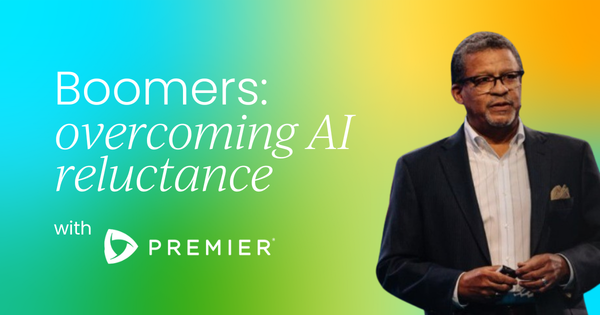
I’ll start with a confession. I am the boomer everyone is talking about.
I was born in 1963, which technically puts me right at the tail end of the Baby Boomer generation.
I sometimes describe myself as a “Boomer-Xer,” because while my birth year places me firmly in one category, my mindset and the way I work often feel split between generations.
That tension (between where we come from and where the world is going) is exactly what makes the conversation about AI adoption so personal for me.
I’ve spent my career in human resources and organizational culture. I’m a retired chief HR officer (sometimes I jokingly call myself a recovering one) and today I serve as the Chief Culture Officer at Premier Inc.
I’m also an ICF-certified executive coach and certified in organizational mindfulness. I recently became a first-time author, which still feels a little surreal.
But titles aside, at my core I consider myself an organizational culture engineer. My work has always been about understanding how humans respond to change and how organizations either support that response or unintentionally sabotage it.
When people talk about boomers being reluctant to adopt AI, they’re not wrong. Adoption has been hard for me too. New platforms, new tools, new ways of working: it can feel relentless. But
I also believe deeply in having an open mind and a growth mindset, and that belief is what has kept me leaning forward instead of retreating backward.
One thing I want to say upfront is this: patience is one of the most human gifts we can offer each other right now. As AI and technology continue to reshape how we live and work, patience may be the most underrated leadership competency we have.
 People Alliance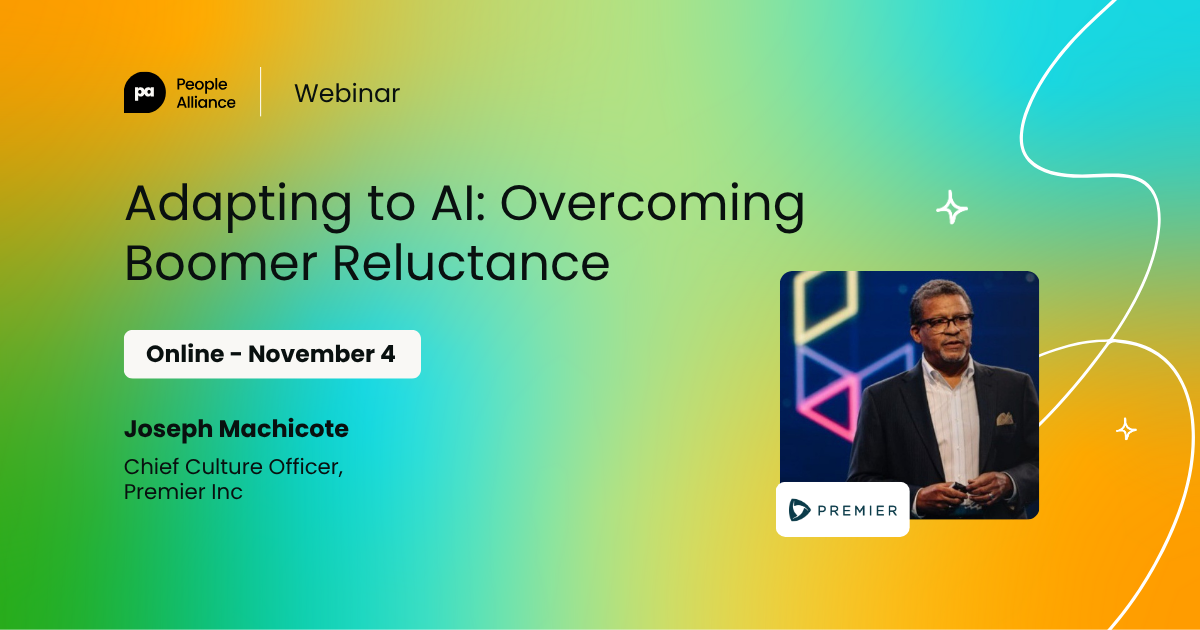
Why we’re talking about AI adoption now
Throughout history, especially in the world of work, one thing has always been true: things change. Sometimes gradually, sometimes overnight. But change is constant.
If there is any single competency that every generation must develop to stay relevant, it’s change capability, the ability to see change coming and run toward it instead of away from it.
AI tools like ChatGPT are not just another software update. They are transforming how work gets done and how decisions are informed. For many boomers still in the workforce, that transformation creates tension.
This generation brings deep institutional knowledge, experience, and wisdom, but often hesitates when confronted with technology that feels unfamiliar, fast-moving, and opaque.
Organizational success depends on everyone building change capability, regardless of age. This isn’t about replacing people; it’s about evolving together.
Where the resistance comes from
When I talk with people in my generation, several concerns surface again and again. There’s uncertainty about how AI actually works.
 Teresa Garanhel
There’s mistrust of the technology itself. There’s fear of being replaced or becoming irrelevant, fears that tend to grow louder as retirement gets closer and career timelines feel shorter.
I heard a quote recently that really stuck with me. It said that no one should worry about AI replacing them. What they should worry about is people who know how to use AI replacing them.
AI itself isn’t the threat. The threat is opting out of learning.
AI will never replicate humanity. It can’t replace judgment, empathy, or lived experience.
But it can help people work faster, see patterns more clearly, and approach problems from new perspectives. Those who learn to use it effectively gain a competitive edge.
I’ve seen this firsthand in hiring. For years, organizations have used assessments that run through algorithms to provide insights about candidates.
I never advocate letting AI make hiring decisions, but I do believe it can serve as what I call “interviewer zero.”
It provides an objective perspective that humans can’t always process as quickly. When used responsibly, it becomes a partner, not a replacement.
Another major source of resistance is concern over data privacy and security. That concern didn’t come out of nowhere. It has deep historical roots.
 Marisa Garanhel
A tsunami of technology
Sometimes resistance isn’t philosophical, it’s simply exhaustion.
I recently sat down and listed all the technologies I interact with in my daily life.
For communication alone, there’s Threads, Instagram, Facebook, TikTok, texting, email, Telegram, LinkedIn. For work support, there’s ChatGPT, Copilot, Siri, Alexa (one of which went off while I was talking about it).
For file storage, Dropbox and Google Drive. For meetings, Google Meet, Teams, Webex, Zoom. For searching the web, Edge, Google, Yahoo, MSN, Ask.com, Bing, Dogpile.
And then there are the AI note-takers: Otter, Fathom, Bubbles, Fireflies, Grain, MeetGeek, Fixa. Even entertainment has fractured into countless platforms: Netflix, Prime, Disney+, Apple TV, Hulu, Peacock, Paramount+, Spotify, and more.
For those who grew up in a world of rapid technological change, this feels natural. For those who didn’t, it feels like a tsunami.
Boomers were raised to focus on one or two things at a time. Multitasking was not the norm. In fact, research tells us that multitasking isn’t nearly as effective as we like to believe, regardless of age.
Patience matters here. I see this dynamic play out in my own home. My wife, who sits squarely in the boomer generation, will be working on her phone while our daughter watches.
Eventually, my daughter will get frustrated, grab the phone, and say, “Let me do that.” That moment captures the generational gap perfectly and the need for empathy on both sides.
The roots of boomer fear
To understand boomer reluctance, you have to understand the world we grew up in.
The Baby Boomer generation emerged in post-World War II America. Unlike World War I, World War II introduced widespread spying, wiretapping, radio surveillance, and coded communication.
That mistrust of technology didn’t disappear when the war ended, it followed people into everyday life.
The Cold War intensified those fears. The United States and Russia spent decades watching each other, listening, recording, and gathering intelligence. Popular culture didn’t help.
James Bond movies glorified surveillance and secret listening devices, reinforcing the idea that technology was always watching.
There was also widespread distrust of government. Agencies like the FBI and CIA collected information on citizens. Stories about Martin Luther King Jr. being surveilled became public knowledge.
Political scandals like Watergate revolved around wiretapping and planted listening devices.
These experiences shaped an entire generation’s relationship with technology. Even today, my wife refuses to have Alexa in our house because she believes it listens to our conversations; and she’s not entirely wrong.
Myths, conspiracies, and reality
I still hear people say AI is controlling our minds through hidden algorithms. My own mother has told me, “Joe, they’re trying to turn us all into robots.” I always tell her we’ll never be robots but I understand where the fear comes from.
Another common belief is that ChatGPT steals private conversations and sells them. ChatGPT itself isn’t capable of malicious intent, but humans absolutely are. Any tool can be misused if the intent is harmful.
Some people believe robots will eliminate human jobs entirely. Having worked in manufacturing environments that used robots for sorting and efficiency, I can say this simply isn’t true.
Robots still require humans to maintain, engineer, and improve them. They are tools, no different than a wrench.
That brings me to one of my favorite metaphors.
AI Is a tool, not a weapon
A screwdriver is a remarkable tool. It has helped build civilizations. It fixes, repairs, and creates. But you could also use a screwdriver to hurt someone. That doesn’t make the screwdriver evil. It means the tool was misused.
AI is the same. It is a tool, not a decision-maker. Unless we weaponize it, it is not a weapon.
I used AI while preparing this very presentation. I used it to check facts, organize ideas, and challenge my thinking. I used it extensively while writing my book. I wrote the stories myself, then ran them through ChatGPT as a kind of editorial partner.
I even asked it to review passages in the voice of Simon Sinek to see how the tone landed.
I named my ChatGPT “Sandy.” I talk to her on my phone and type to her on my computer. She gives me immediate feedback because feedback is data. Used responsibly, that data helps us improve.
 Matthew Pepe
Change capability and the growth mindset
If I had to rank the most important competencies for success at work, change capability would easily be in the top three.
Transformational change isn’t a small tweak. It’s a radical departure from the past. I’ve lived through enormous technological shifts in my lifetime.
When CDs first came out, I was blown away. Suddenly, you could hear a musician take a breath before playing a note, something vinyl didn’t capture the same way.
One day, my wife and I were sorting through our vinyl records, deciding which ones to keep now that CDs were taking over. Our young son walked in, looked at the albums, and said, “Wow, those are really big CDs.” He had never seen a vinyl record before.
That moment perfectly captured how generational context shapes perception.
Change requires a growth mindset, the ability to see challenges as opportunities. The opposite is a fixed mindset, which says, “Things are fine the way they are. Why change?”
When change shows up, we all have a choice. We can pick up a pitchfork and a torch and storm the establishment, or we can pick up a flashlight and explore what’s ahead.
The establishment always moves forward, whether we like it or not. The train doesn’t stop just because someone decides to get off.
People are watching how leaders respond to change. During times of uncertainty, emotions run high. We can feel angry, scared, sad, curious, and innovative all at once. A growth mindset doesn’t deny those emotions, it channels them toward learning.
The journey from old land to new land
Change is a journey. We start in what I call “old land,” move through a messy middle (the delta state) and eventually arrive at “new land.” During that middle phase, we lose time, energy, motivation, and sometimes our sense of safety.
That’s when people end up in what I affectionately call “pity city.” It’s okay to visit pity city. It’s not okay to live there.
The way out is intentional change management. Communication, training, and rewards reduce the dip. They help people move through change faster and with less fear.
Think about moving homes. At first, it feels exciting. Then the packing, expenses, utilities, and chaos kick in. On the first night, you can’t even find a fork. But a few months later, you forget how hard it was because the new place feels like home.
That’s how change works.
 Connie White
Moving forward together
Boomers aren’t the problem. Resistance to change is a human condition. AI adoption is simply today’s version of that challenge.
The path forward starts with curiosity instead of fear. It means treating AI as a partner, not a threat. It means building cultures of adaptability and continuous learning.
When someone asks how to balance respecting people’s preferred ways of working while still pushing AI adoption, my answer is simple: meet people where they are.
Let them be heard. Acknowledge their fears, including your own. Respect means “to look again.” When we take the time to truly see one another, progress becomes possible.
I still have fears about AI. But I also have a flashlight in my hand, and I’m willing to explore. If we do that together (with patience, respect, and intention) we don’t just survive change. We grow through it.
And that, to me, is the real work of culture.
This article is based on Joseph's brilliant talk at the AI for People & HR Summit, and you can find it on-demand here.
Join our Slack community to meet other people leaders, get strategies and ideas to apply in your role, and so much more.
 People Alliance