
 Follow us on LinkedIn
“Done right, a performance review is one of the best opportunities to encourage and support high performers and constructively improve your middle- and lower-tier workers.” – Kathryn Minshew, Co-Founder and ex-CEO of The Muse
When done well, performance reviews drive clarity, engagement, and growth across your organization.
When done poorly, they become dreaded formalities that frustrate managers, disengage employees, and quietly erode trust.
So, here’s what you need to do to avoid common pitfalls.
What is a performance review?
At their best, performance reviews are structured conversations that help people understand where they stand, where they’re going, and how they can get there.
They’re not meant to be surprises, report cards, or one-sided verdicts. They should, however, create alignment and momentum.
As an HR or people leader, you can use performance reviews to reinforce expectations, recognize meaningful contributions, and surface risks early.
For example, a well-run review can clarify why a high performer feels stuck, why a manager’s team is disengaged, or why a previously strong employee is struggling.
Performance reviews also play an important role in shaping culture. What you reward, what you challenge, and what you ignore all send strong signals.
If collaboration, accountability, or innovation matter to your company, those values should show up clearly in how performance is reviewed and discussed.
Why performance reviews break down
Most performance reviews fail because the process isn’t designed to support honest, useful conversations.
One common issue is recency bias. A manager remembers the last project that went wrong and forgets six months of solid execution.
Another issue is vague feedback. Telling someone to “be more strategic” or “communicate better” sounds reasonable, but gives them nothing concrete to work with.
You’ve likely also seen performance reviews suffer when expectations were never clearly defined. If goals shifted mid-year or success was never clearly articulated, reviews feel subjective and unfair. That’s when employees disengage or become defensive.
You can avoid these breakdowns by anchoring performance reviews in clear goals, documented examples, and shared definitions of success.
When people understand what they’re being evaluated on and why, the conversation becomes far more productive.
Performance reviews best practices
Effective performance reviews follow a few core principles that keep the process fair, useful, and credible for both managers and employees.
When you get these right, reviews stop feeling like an obligation and start driving real performance outcomes.
Be consistent
You can’t expect employees to take performance reviews seriously if the experience varies wildly from manager to manager.
As an HR or people leader, your role is to create a clear, repeatable framework that gives managers structure while still allowing room for nuance.
For example, when every review includes a discussion of goals, impact, strengths, and development areas, employees understand what “good” looks like regardless of who their manager is.
Anchor feedback in evidence
Performance reviews lose credibility the moment feedback feels subjective or emotional.
Instead of relying on general statements, encourage managers to reference specific behaviors and outcomes.
For instance, saying “you’re a strong collaborator” is far less effective than saying, “You consistently brought cross-functional partners into planning discussions early, which reduced rework and improved delivery timelines.”
That level of specificity builds trust and makes feedback actionable.
Be clear
Performance reviews should never leave employees guessing what the feedback actually means.
Vague language like “needs to be more proactive” or “should think more strategically” creates confusion and frustration.
A more effective approach is to connect expectations to observable actions.
For example, “Being more proactive means flagging risks earlier and proposing solutions before deadlines are at risk.” When employees understand exactly what to do differently, improvement becomes possible.
Strive for balance
Too much focus on weaknesses can feel demoralizing, while too much praise without challenge can stall growth. The most effective reviews acknowledge what’s working while clearly addressing where improvement is needed.
For example, you might recognize an employee’s strong execution and follow that with, “Your delivery has been consistently strong, and the next opportunity for growth is building confidence in presenting your ideas to senior stakeholders.”
This framing reinforces strengths while encouraging development.
Look forward
While past performance provides context, your real value as an HR leader comes from helping managers use reviews to shape future outcomes.
Each review should end with clear next steps, whether that’s new goals, development opportunities, or changes in focus.
For example, if an employee struggled with prioritization, the review shouldn’t stop at identifying the issue.
It should result in an agreed-upon plan, such as redefining success metrics or introducing regular priority check-ins.
Have conversations, not verdicts
When managers do all the talking, reviews become defensive and disengaging. Encourage two-way dialogue by building in space for employee reflection and response.
An employee who says, “I felt unclear on priorities during the last quarter,” is offering valuable insight that can improve performance moving forward.
When employees feel heard, they’re far more likely to act on feedback.
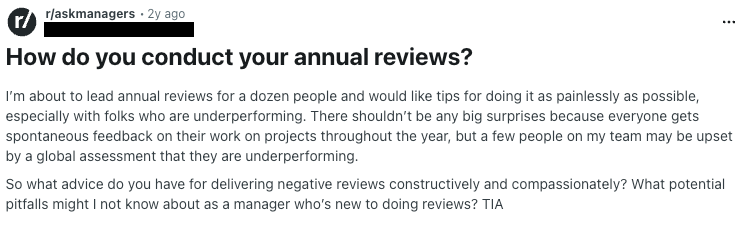
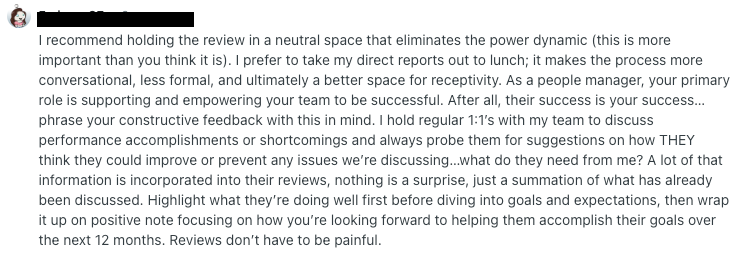
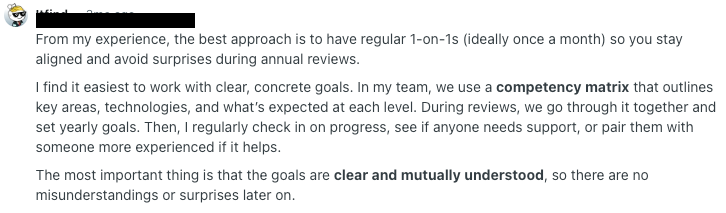
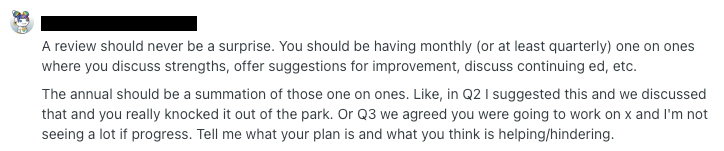
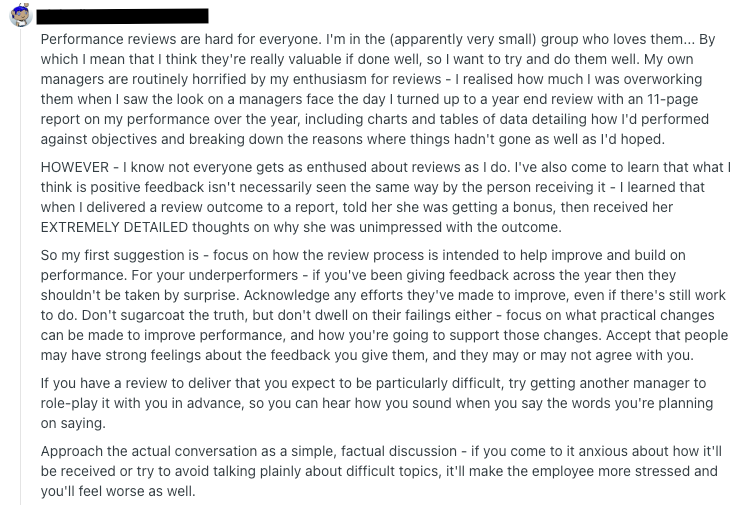
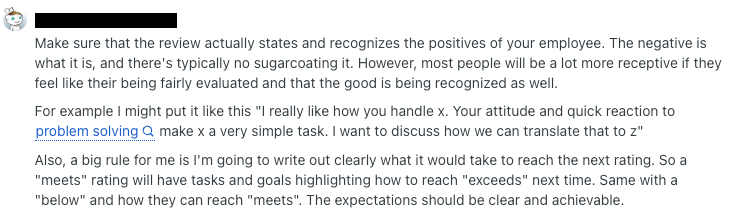
Here’s what people on Reddit have to say about it:
How to prepare managers and employees for performance reviews
Preparation is where most performance reviews either succeed or fail. As an HR or people leader, you can dramatically improve review quality by setting clear expectations around preparation.
Managers should come to performance reviews with documented examples tied to goals. Encourage them to review notes from one-on-ones, project outcomes, and feedback from peers or stakeholders.
This helps prevent bias and ensures the conversation reflects the full review period.
Employees should also be encouraged to prepare. Asking them to reflect on their achievements, challenges, and goals creates balance and ownership.
For example, you might prompt employees to answer questions like, “What accomplishment are you most proud of this period?” or “What support would help you perform better next cycle?”
How to conduct performance reviews
Research shows that poorly delivered performance reviews can do more harm than good: only 14% of employees strongly agree that performance reviews inspire them to improve performance.
Without a clear flow, reviews can jump between topics, miss critical context, and leave employees unsure about what actually matters.
As a people leader, your role is to help managers follow a structure that creates clarity, fairness, and forward momentum.
1. Goals and expectations
A strong performance review begins by revisiting goals and expectations that were set at the start of the review period.
This step anchors the entire conversation in shared understanding. When goals are revisited upfront, feedback feels grounded rather than subjective.
Instead of writing a generic comment, a prepared manager might write:
“Through Q2 and Q3, your weekly status summaries helped cross-team alignment and reduced time-to-decision by 18%. I also noticed challenges with stakeholder follow-ups in May and June; let’s unpack that.”
This immediately reminds both parties what success was supposed to look like, and it also anchors the conversation in facts.
2. Achievements and strengths
This is not about generic praise or softening difficult feedback. It’s about reinforcing the behaviors and outcomes you want to see repeated.
For example, instead of saying, “You did well this quarter,” a manager could say, “Your proactive check-ins with clients helped identify concerns earlier, which directly contributed to a 15% increase in renewals.”
This kind of feedback ties performance to business impact and helps employees understand why their work matters.
3. Areas that need development
This is often the most delicate part of the conversation, and structure matters here more than anywhere else.
Feedback should focus on behaviors and outcomes, not personality traits. Framing development as the “next step” rather than a shortcoming keeps the tone constructive.
For example, a manager might say:
“You’ve shown strong individual execution and ownership of your work. The next opportunity for growth is building confidence in delegating tasks so the team can scale more effectively.”
This positions development as progression, not failure.
4. Problem-solving and reflection
This is where two-way dialogue is essential.
Asking questions like, “What made this goal challenging?” or “What would you do differently if you had the chance?” allows employees to share context that may not be visible to managers.
For HR teams, this step often surfaces systemic issues such as unclear priorities, resource gaps, or misaligned expectations.
 Teresa Garanhel
5. Forward-looking goals and support
Without this step, even a strong review can feel incomplete. Clear next steps turn feedback into action.
For example:
“Over the next quarter, we’ll focus on strengthening your delegation skills. I’ll support this by having you lead the next project kickoff and by checking in biweekly to review workload distribution.”
Ending the conversation this way ensures alignment, accountability, and momentum.
6. Follow up consistently
Feedback should be continuous, not a single event.
Frequent check-ins are essential as part of performance management. For example, quarterly reviews or continuous feedback cycles ensure that conversations are relevant and timely.
A follow-up plan might include monthly rough check-ins, progress tracking dashboards, or designated one-on-one time to revisit goals.
Manager action after the review:
“Let’s touch base every two weeks to review your progress on stakeholder communication and adjust if needed.”
This keeps performance goals alive rather than letting them fade after the review meeting.
Performance review questions
Performance review questions generally fall into a few core categories. Each category plays a different role in shaping the conversation.
Performance and impact questions
These questions focus on outcomes and contributions rather than effort alone. They help employees articulate impact and help managers assess results.
Examples include:
- “What accomplishments from this review period are you most proud of?”
- “Which goals did you make the most progress on, and what contributed to that success?”
- “Where do you feel your work had the greatest impact on the team or business?”
These questions encourage evidence-based discussion instead of subjective opinions.
Strengths and effectiveness questions
These questions help reinforce positive behaviors and identify what employees should continue doing.
Examples include:
- “What strengths did you rely on most during this review period?”
- “What feedback have you received that you found most helpful?”
- “Which parts of your role feel most aligned with your skills?”
For HR leaders, these questions are essential for building strength-based performance cultures.
Challenges and improvement questions
These questions surface obstacles, skill gaps, or systemic issues without assigning blame.
Examples include:
- “What challenges made your work more difficult this cycle?”
- “Where do you feel you struggled or could have approached things differently?”
- “What barriers slowed progress on your goals?”
These questions often reveal process, resource, or expectation gaps that HR can address at a broader level.
Feedback and collaboration questions
Performance reviews shouldn’t only evaluate the employee; they should also assess the environment around them.
Examples include:
- “What support from your manager helped you perform well?”
- “Where could communication or collaboration have been stronger?”
- “What feedback do you wish you had received earlier?”
For HR, these questions provide insight into management effectiveness and team dynamics.
Growth and development questions
These questions shift the review from evaluation to future planning.
Examples include:
- “What skills would you like to develop next?”
- “What type of work would you like more exposure to?”
- “Where do you see opportunities for growth in your role?”
They’re critical for retention, engagement, and career development conversations.
Forward-looking and goal-setting questions
These questions ensure the performance review ends with clarity and momentum.
Examples include:
- “What should success look like in the next review period?”
- “What goals should we prioritize moving forward?”
- “What support or resources would help you perform at a higher level?”
For HR leaders, these questions help ensure performance reviews translate into action, not just reflection.
How HR teams should use performance review questions
Performance review questions work best when they’re:
- Shared with employees in advance so they can prepare
- Used consistently across teams and roles
- Balanced between reflection, feedback, and future planning
- Framed in plain, human language
When performance review questions are treated as conversation guides rather than checkboxes, they become a powerful tool in your performance management system.
Sample goals for performance review conversations
Without clear goals, performance reviews become retrospective conversations with little impact on future results.
Your role is to help managers and employees set goals that are specific, achievable, and clearly tied to both business needs and individual growth.
The strongest performance review goals do three things at once:
- They clarify expectations
- Encourage development
- Create measurable outcomes
Below are examples of performance review goals you can use and adapt across roles.
Performance review goals tied to role effectiveness
These goals focus on improving day-to-day execution and impact. They work best when framed around outcomes rather than effort.
For example, instead of a goal like “be more efficient,” a clearer performance review goal would be:
“Improve task prioritization by creating weekly work plans and reviewing progress in one-on-ones, with the goal of meeting all critical deadlines over the next quarter.”
In a client-facing role, a performance review goal might sound like:
“Increase client satisfaction by conducting monthly check-ins and proactively addressing concerns, aiming to improve retention by the end of the review period.”
These types of goals make it obvious what success looks like and how progress will be measured.
Development and skill-building goals
Development goals are essential for keeping employees engaged and preparing them for future responsibilities. They should be realistic and tied to observable behavior changes.
For example, a development-focused performance review goal could be:
“Build confidence in presenting by leading at least two team presentations per quarter and gathering feedback afterward.”
Another example might be:
“Strengthen written communication by drafting project summaries for stakeholders and incorporating feedback from peers over the next six months.”
These goals emphasize growth without implying current performance is inadequate.
Leadership and people management goals
For managers and emerging leaders, goals for performance reviews should reflect how they support and enable others.
A strong leadership goal might be:
“Improve team engagement by holding consistent biweekly one-on-ones and documenting development goals for each direct report.”
Another example could be:
“Develop delegation skills by assigning ownership of at least one major project to a team member and providing regular coaching check-ins.”
These goals for performance review reinforce the idea that leadership performance is measured by team outcomes, not just individual output.
Collaboration and communication goals
Many performance challenges stem from misalignment rather than lack of effort. Goals in this category help address cross-functional friction.
For example:
“Improve cross-functional collaboration by involving key stakeholders earlier in project planning and sharing weekly status updates.”
Or:
“Enhance communication clarity by summarizing decisions and next steps after meetings and sharing them with relevant teams.”
These goals help reduce confusion and improve execution across teams.
Stretch goals for high performers
High performers often need goals that push them beyond their current scope without setting them up for burnout.
A stretch performance review goal might be:
“Take ownership of mentoring a new team member to support onboarding and knowledge transfer.”
Another example could be:
“Lead a cross-functional initiative to improve an existing process and present outcomes to leadership.”
These goals signal trust and investment in long-term potential.
A ready-to-use performance review template
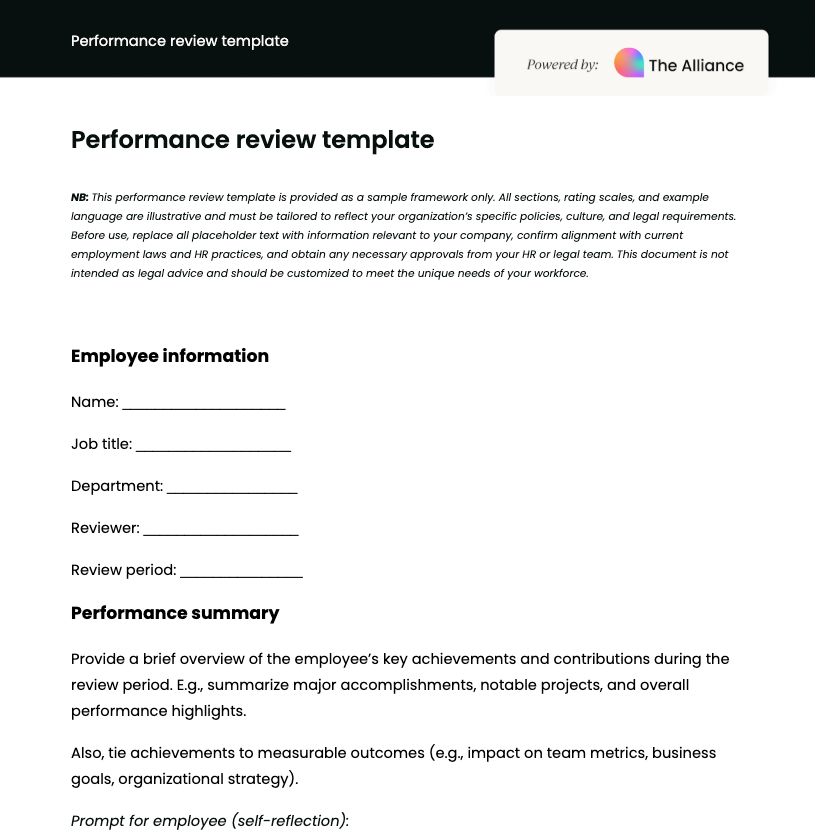
You don’t need to reinvent the wheel to run effective performance reviews. A simple, flexible template can go a long way.
And we have one for you right here. Becoming an Insider member (which is free, by the way) means you get access to many templates and frameworks designed to make your job easier, including performance reviews.
You can download in the format that works best for you. 👇