
 Follow us on LinkedIn
Every HR and people leader wants to believe their company is fair, inclusive, and built on merit.
Yet, research continues to show that unconscious bias in the workplace remains one of the most significant barriers to equity and performance.
In fact:
- Nasdaq found that 55% of employees have experienced discrimination at their current company, while 61% have witnessed discrimination happen to others, whether at their current org or a previous one.
- A recent Skillcast survey of 2,000 UK professionals revealed nearly one-third of employees have experienced or witnessed bias in the workplace, with 39% of respondents identifying senior management as the primary source of that bias.
- Employees who perceive bias are nearly “three times as likely to be disengaged at work.”
- Disengaged workers cost companies between $450 and $550 billion a year.
Unconscious bias doesn’t stem from bad intentions, but from human nature, since our brains are wired to create shortcuts that help us make quick judgments.
The problem is when these automatic judgments shape decisions about people: who we hire, promote, or listen to.
Understanding bias and how it works
To create change, HR leaders must first understand the mechanisms of bias.
Unconscious bias operates below the surface. It’s the set of automatic associations we develop over time based on experiences, culture, and exposure.
These biases are often invisible even to ourselves. They affect how we perceive competence, trustworthiness, or leadership potential, long before we consciously form an opinion.
Implicit bias, closely related, refers to the subtle mental associations that shape our reactions.
It’s that quick, gut-level judgment that makes us feel more at ease with certain people or skeptical of others.
The distinction between implicit and unconscious bias is largely academic, since both represent unintentional tendencies that influence workplace interactions.
The key insight is that having bias doesn’t make a leader unethical, but failing to recognize and address it does.
As HR professionals, your job is to create systems that surface these invisible forces and design organizational structures that minimize their impact.
Awareness alone isn’t enough; change must be embedded in every process, policy, and leadership behavior.
 Teresa Garanhel
Why you should care about bias
People leaders (and people operations pros) shape the employee experience more than any policy ever could.
Every hiring choice, feedback conversation, promotion decision, or team meeting communicates what (and who) the organization values.
If bias, even unconscious bias, seeps into those everyday interactions, it can quietly erode culture, performance, and trust. That’s why tackling bias is a core leadership responsibility.
1. Bias undermines fairness
When employees notice patterns of favoritism, inequity, or double standards, they grow resentful, and for good reason.
Unchecked bias goes beyond hurt feelings because it damages the very trust that keeps teams cohesive and high-performing.
2. Bias limits organizational potential
When bias influences who gets hired, mentored, or promoted, a company unintentionally filters out diversity of thought, which is one of the strongest predictors of innovation.
For people leaders, this translates into a competitive must-have: removing bias helps you fuel adaptability, creativity, and growth.
3. Bias drives turnover and burnout
Employees who feel marginalized or undervalued are far more likely to disengage or leave.
And turnover costs are steep. Replacing an employee can cost between 50% and 200% of their salary once recruitment, onboarding, and productivity loss are factored in.
But the deeper cost is cultural: when excluded employees leave, they take their perspective, institutional knowledge, and trust with them.
 Sabrinthia Donnelly
4. Bias creates legal and reputational risk
From pay gaps to promotion disparities, bias-driven decisions can expose your company to serious compliance risks.
For instance, more companies are using AI-driven recruitment systems, but these have been found to contain bias: a recent study found that “LLMs favored white-associated names 85% of the time, female-associated names only 11% of the time, and never favored Black male-associated names over white male-associated names.”
Addressing bias is a risk management, since it protects the workforce but also your company’s credibility and integrity.
5. Bias erodes engagement and belonging
The feeling of belonging is one of the strongest predictors of employee engagement. When employees sense bias in how decisions are made, belonging suffers.
And here’s the proof: a BetterUp report found that “workplace belonging leads to a 56% increase in job performance, a 50% reduction in turnover risk, and a 75% decrease in employee sick days.”
6. Inclusive leadership is now a core competency
The modern workplace is diverse by design, often with global, multigenerational, and cross-cultural teams.
The ability to recognize and mitigate bias is now as essential to leadership as financial acumen or strategic planning.
So, you must embed bias awareness and inclusive leadership into any competency models, performance reviews, and leadership development programs you create.
7. It’s the right thing to do
Beyond business cases and metrics, caring about bias is an ethical imperative.
Work is a central part of life; it shapes identity, dignity, and opportunity, and creating a workplace where everyone has equal access to those things is a huge responsibility.
 Teresa Garanhel
Types of bias HR leaders should recognize
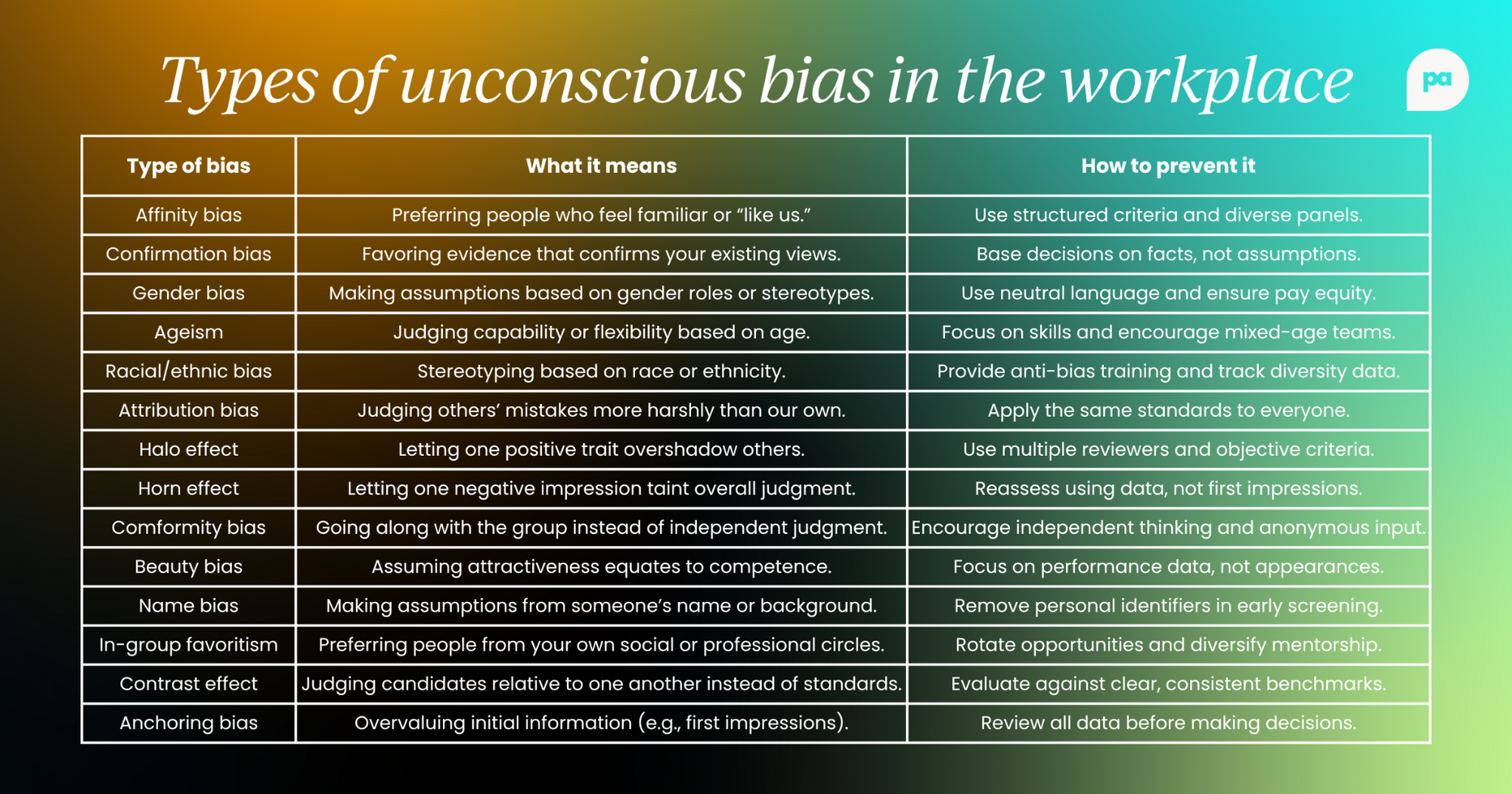
The first step in dismantling bias is being able to name it. Here are the most common types that appear in workplaces:
Affinity bias
Favoring people who share similar interests, backgrounds, or experiences, which often leads to homogenous teams.
Confirmation bias
Seeking or interpreting information that confirms existing beliefs or assumptions, while ignoring contradictory evidence.
Gender bias
Making assumptions about abilities, roles, or traits based on someone’s gender. E.g., seeing men as more “decisive” or women as more “nurturing.”
Age bias
Judging people’s abilities or potential based on their age, like assuming older employees resist change or younger ones lack authority.
Racial/ethnic bias
Stereotyping or forming judgments about individuals’ competence or character based on their race or ethnicity.
Attribution bias
Attributing others’ behavior to personality (“she’s careless”) but our own to circumstances (“I was busy”).
Halo effect
Allowing one positive trait (e.g., charisma, education) to overly influence the perception of someone’s overall ability.
Horn effect
The opposite of the halo effect; one negative trait (e.g., a mistake or flaw) unfairly colors the entire perception.
Conformity bias
Aligning opinions with the group, even when you disagree, to avoid conflict or exclusion.
Beauty bias
Assuming people who are conventionally attractive are more capable, trustworthy, or intelligent.
Name bias
Making assumptions about a person’s background or capability based on how their name sounds.
In-group favoritism
Giving preference to people from one’s own “group” (e.g., same department, school, gender, or ethnicity).
Contrast effect
Evaluating someone not on their own merit, but in comparison with others. E.g., a good candidate looks average after an excellent one.
Anchoring bias
Relying too heavily on the first piece of information received (e.g., initial salary expectations influencing final offers).
What unconscious bias in the workplace looks like
Unconscious bias doesn’t usually show up as overt discrimination.
Instead, it hides in day-to-day decisions, habits, and interactions, manifesting as subtle patterns that, over time, shape who feels valued, who advances, and who leaves.
Here are some common real-world examples of what unconscious bias can look like across different stages of the employee experience:
Recruitment and hiring
Bias often begins before an employee even joins the organization.
- Resumes with “ethnic-sounding” names receive fewer callbacks than identical ones with “traditional” names.
- Job descriptions can include gendered language like “dominant,” “nurturing,” or “aggressive,” which subtly discourages certain applicants.
- Hiring managers favor “culture fit” over skills, unconsciously preferring candidates who mirror existing team demographics.
- Accent bias during interviews can lead to assumptions about competence or intelligence.
 Teresa Garanhel
Interactions and communication
Bias often shows up in small, everyday behaviors that affect belonging and participation.
- Certain voices are interrupted or dismissed more frequently, often women or junior staff.
- Ideas proposed by one group go unnoticed until repeated by someone else (the “hepeating” phenomenon).
- Microaggressions, which are subtle comments or jokes that question someone’s competence or identity (“You’re so articulate for your age”).
- Unequal access to informal networks and social circles, leaving some employees excluded from key information or opportunities.
Performance evaluations
Even structured review systems can be influenced by bias.
- Women receive more personality-based feedback (“be more confident”) while men receive more action-oriented feedback (“improve technical skills”).
- Managers may unconsciously assume certain groups are more “leadership-ready.”
- Employees who don’t match a traditional leadership mold, like introverts, are overlooked for promotions.
- Confirmation bias reinforces pre-existing narratives (“She’s emotional” or “He’s a natural leader”).
Development and promotion
Bias can subtly shape who gets access to growth opportunities.
- High-visibility projects or mentorships often go to those already in the “in-group.”
- Stereotypes influence perceptions of ambition or readiness (e.g., assuming mothers aren’t interested in advancement).
- Affinity bias leads leaders to sponsor people who remind them of their younger selves, perpetuating homogeneity.
Pay and reward
Compensation decisions can also reflect unconscious bias.
- Studies consistently show women and minority employees negotiate less successfully and are often offered lower starting salaries for identical roles.
- Performance-based bonuses can be influenced by subjective evaluations rather than measurable outcomes.
- “Visibility bias” rewards those who self-promote or work in more visible functions, rather than those whose contributions are behind the scenes.
Team dynamics and collaboration
Bias influences who we trust, delegate to, or include in conversations.
- People leaders unconsciously assign easier or less strategic work to employees they see as less capable.
- Employees may be left out of social gatherings or informal decision-making because of perceived “difference.”
- Team members may gravitate toward those similar to them when forming project groups, reinforcing silos.
Leadership and organizational culture
At the top, unconscious bias can shape an organization’s entire identity.
- Leadership teams that lack diversity often reproduce their own image in hiring and promotions.Executive discussions subtly favor perspectives that “sound like leadership,” sidelining alternative viewpoints.
- A lack of representation leads employees to feel invisible or undervalued, driving disengagement and turnover.
Everyday micro-behaviors
Unconscious bias doesn’t always involve major decisions. Sometimes, it’s the micro-moments that end up sending macro-signals.
- Assuming a younger colleague is a junior.
- Asking a woman to take meeting notes when it’s not her role.
- Mispronouncing names repeatedly without making an effort to correct it.
- Commenting on someone’s hair, clothing, or accent as “different.”
- Over-explaining concepts to certain people (“mansplaining” or “whitesplaining”).
Strategies to overcome unconscious bias in the workplace
Build self-awareness and personal accountability
Every HR leader must begin by examining their own blind spots.
Self-reflection, coaching, and feedback are powerful tools for growth, so encourage leaders to maintain a “bias awareness journal” to document moments of judgment and reflection, or even take the Harvard Implicit Association Test.
Embed inclusion into systems
Awareness training alone won’t transform culture. Sustainable progress requires systemic intervention by designing processes that make bias less likely to influence outcomes.
For example:
- Blind resume reviews to focus on qualifications rather than names or demographics.
- Structured interviews with standardized questions and scoring rubrics.
- Diverse interview panels that bring multiple perspectives to selection decisions.
- Transparent promotion and pay frameworks with clear, measurable criteria.
Invest in data-driven insights
Data makes inequality much more visible. Regularly analyze workforce metrics, such as hiring rates, promotion outcomes, and turnover by demographic, to identify disparities.
Publishing these insights internally demonstrates transparency and accountability.
Prioritize empathy and active listening
Encourage leaders and managers to move beyond token gestures and truly listen to employee experiences, especially from marginalized groups.
When individuals share stories of bias, resist the instinct to defend or rationalize. Instead, ask questions like, “What would make this environment feel more supportive for you?” or “How can we do better?”
Empathetic listening builds psychological safety.
Champion representation
Representation is about power, influence, and visibility. Leaders who look, think, and experience the world differently bring fresh insight and challenge groupthink.
As HR professionals, you can build structures that elevate underrepresented voices:
- Create sponsorship programs pairing executives with high-potential talent from marginalized backgrounds.
- Offer leadership development pathways that intentionally cultivate diversity in succession pipelines.
- Conduct regular pay equity reviews to ensure compensation fairness.
When employees see people like themselves in leadership, it sends a powerful message.
Facilitate continuous learning
One-off bias workshops rarely lead to meaningful change. Lasting impact requires an ongoing commitment to learning, supported by skilled facilitators.
Partner with experts who can create interactive, psychologically safe learning environments. Techniques like role-playing, scenario analysis, and peer reflection make that a lot easier.
In addition, you should also link this to measurable goals, like improved diversity in hiring.
Create feedback loops
Establish clear expectations for inclusive behavior across all leadership levels and integrate them into performance metrics.
Encourage open dialogue about progress and setbacks. Consider forming employee resource groups or DE&I groups that provide real-time feedback on policies and practices.
The reduction of unconscious bias in the workplace is a continuous cycle of reflection, adjustment, and growth.
 Connie White
TL;DR
Eliminating unconscious bias in the workplace begins with personal reflection but succeeds through structural change. It’s about asking the difficult questions:
- Who isn’t represented in our leadership meetings?
- Whose voice goes unheard in decision-making?
- What patterns in our data reveal inequities we’ve overlooked?
The answers may challenge you, but they also help you create a more inclusive and safe workplace.
Join our (free) Insider membership to get templates and frameworks designed to streamline your day-to-day (such as verbal warning and employee write-ups you don't need to do from scratch), as well as exclusive content.
 People Alliance