

 Follow us on LinkedIn
Employer health benefit costs are projected to rise by the most in over two decades in 2027, so benefits administration now has a direct effect on budgets.
A recent survey projects an average 8.2% rise in health benefit cost per employee for 2027, the steepest since 2003, even after employers' planned cost-cutting.
At the same time, new IRS limits, the One Big Beautiful Bill Act and ACA reporting changes mean plan documents, payroll systems and employee communications all need updating.
 Teresa Garanhel
What is employee benefits management and administration?
Employee benefits administration is the comprehensive process of designing, implementing, and managing a company’s employee benefits program.
It’s a strategic function that goes beyond simple paperwork and is important for attracting, retaining, and engaging talent.
Benefits management usually refers to the strategy: deciding what to offer, why, and at what cost.
Benefits administration is the execution: enrollment, eligibility, compliance, vendors and communication. In smaller organizations, the same person or team often handles both.
Key elements include:
- Health and wellness programs (medical, dental, vision, mental health, fitness).
- Financial benefits (retirement savings, health savings accounts (HSAs), flexible spending accounts (FSAs), student loan support, financial wellness tools).
- Work-life perks (flexible work, childcare, caregiving support, paid parental leave, lifestyle stipends).
- Career growth benefits (learning budgets, coaching, professional development).
- Equity and inclusivity (benefits that support diverse employee populations).
The administration of employee benefits is the behind-the-scenes engine that makes a benefits program work.
When done well, it not only ensures legal compliance and manages costs, but also creates a positive, seamless experience that makes employees feel valued and supported.
 Sabrinthia Donnelly
The role of benefits administration
Benefits administration is the hands-on execution. It's about the people, processes, and technology that ensure your employees actually get the benefits they're promised.
In 2026, effective benefits administration isn't just about shuffling paperwork. It requires delivering a seamless, transparent experience and covers a lot of ground, such as:
Onboarding and enrollment
This is the first touchpoint for new hires. It's about making the process of understanding and signing up for benefits as simple as possible, whether it's during their first week or your company's open enrollment period.
 Sabrinthia Donnelly
Ongoing management
Benefits don't stop after enrollment. Administration handles all day-to-day stuff, like processing life event changes (think marriage or a new baby), confirming eligibility, and managing annual renewals.
Compliance and reporting
This is a huge one. Benefits administrators are on the front lines of staying compliant with complex and ever-changing laws, such as the ACA, COBRA, and ERISA.
They're the ones who ensure the company avoids costly penalties by handling required reporting and audits.
Vendor management
You can't do it all alone. Administration includes building and maintaining strong relationships with all your partners such as insurance carriers, retirement plan providers, wellness platforms and third-party administrators.
Employee communication
A benefits program is only valuable if employees know what they have and how to use it. Administration is responsible for clear, consistent communication that helps employees get the most out of their plans, which in turn boosts engagement and satisfaction.
Why effective administration of employee benefits matters
The stakes have never been higher for HR teams when it comes to getting employee benefits management right. Here’s why:
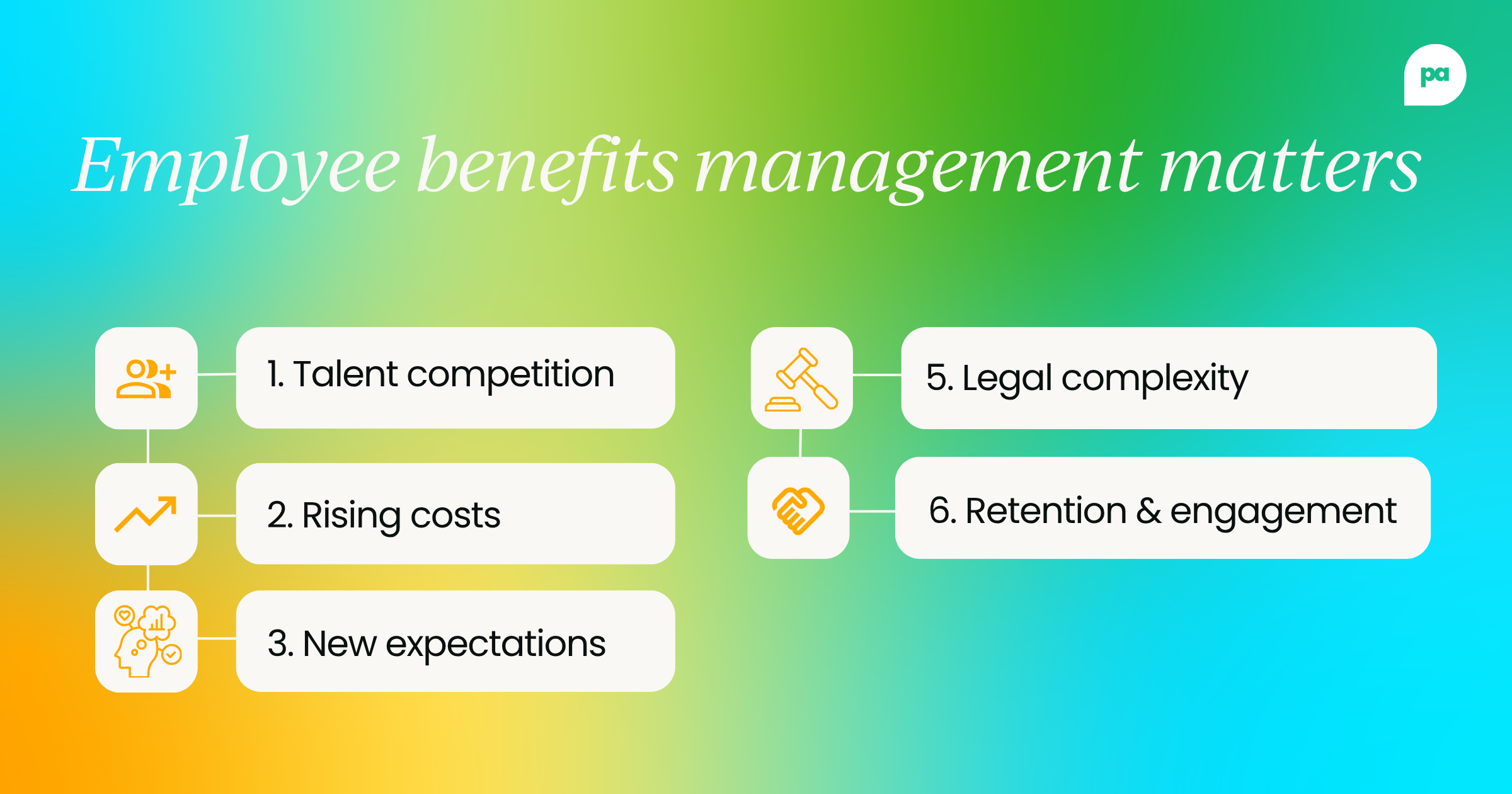
1. Competitive talent markets
With skills shortages in industries like tech, healthcare, and engineering, benefits are often the deciding factor for candidates choosing between employers.
Top candidates are looking for a benefits package that signals a company's commitment to their well-being. A thoughtful, robust program can be your greatest recruiting tool.
2. Rising costs
Healthcare costs are climbing faster than they have in decades. Aon forecasts a 9.5% rise in employer healthcare costs for 2027, lifting average spend to more than $19,000 per employee.
The Business Group on Health's survey found employers expect a median 9.2% increase in 2027, and warned that employers have underestimated actual medical spending for three years running.
Employees feel it too. Aon estimates employees will pay an average of $5,297 toward their healthcare coverage in 2026, up from $4,909 in 2025, combining payroll contributions and out-of-pocket costs.
This forces HR and business leaders to walk a tightrope. The challenge is to create a benefits program that is both affordable for the company and valuable enough to attract and retain employees.
3. Shifting employee expectations
Today's workforce expects more than just basic health insurance. They demand flexibility, personalization, and holistic well-being support that addresses mental, financial, and physical health.
Employers are responding. A recent survey found paid parental leave rose to 46% of employers, a 7-point jump from 2025.
A modern benefits strategy must meet these evolving expectations to keep employees engaged and satisfied.
 Teresa Garanhel
4. Legal complexity
As remote and global work become the norm, so does the complexity of compliance. Benefits managers are now responsible for navigating a patchwork of local, state, and international regulations.
A single misstep can lead to significant legal and financial penalties, making strong oversight non-negotiable.
5. Retention and engagement
A well-managed benefits program is a powerful statement. When employees feel their company is invested in their well-being, it directly boosts loyalty, improves productivity, and strengthens company culture.
But spending more doesn't automatically deliver results. In MetLife's 2026 study, 62% of employers had increased their benefits investment over the past year, yet health and productivity measures stayed mostly flat.
How benefits are administered and communicated matters as much as what's offered.
Simply put, a great benefits experience can be the difference between an employee staying for the long haul or looking for the next opportunity.
 Sabrinthia Donnelly
Best practices in employee benefits administration
Effective benefits administration and management requires a strategic approach that is data-driven, technology-forward, and deeply personalized.
The key is to shift from simply managing plans to actively leveraging benefits as a tool for attracting talent, improving engagement, and supporting overall employee wellbeing.
So, let’s break down the best practices:
1. Automate where possible
Manual enrollment and tracking are a thing of the past. They're not only time-consuming for HR but also prone to costly errors.
How to apply it: Use a modern HRIS or benefits administration platform that integrates seamlessly with your payroll and compliance systems. This allows you to automate everything from enrollment reminders to eligibility tracking and status updates after life events.
With the 2027 limit changes, check that your platform and payroll provider update contribution caps automatically.
2. Use AI and data analytics to personalize
A one-size-fits-all benefits plan is a non-starter. Data is the key to creating a personalized, high-value program. To apply this type of approach, start by tracking utilization rates to see which benefits your employees are actually using.
Identify gaps in your offerings or communication. For example, you might discover that a specific benefit is underused simply because many employees aren’t even aware of it.
You can also use predictive analytics to forecast costs and design plans that meet future employee needs.
This matters more now that forecasts have repeatedly come in too low. Model several cost scenarios, not just one.
AI is also becoming a benefit in its own right. Employer-sponsored AI tool subscriptions doubled from 16% in 2025 to 33% in 2026, the biggest one-year jump in the survey, while formal training to build new skills fell 7%.
If you roll out AI tools, pair them with training and clear usage guidelines.
 Teresa Garanhel
3. Offer flexible benefits
What a 25-year-old remote worker wants is very different from what a 45-year-old parent needs. A flexible benefits model caters to this diversity.
You could try to provide a flexible “points” or "stipend" system that allows employees to allocate funds to categories that matter most to them, whether it’s for wellness, commuting, childcare, or professional development.
Introduce voluntary, add-on benefits like pet insurance, fertility support, or legal assistance.
Flexibility is also becoming more targeted. SHRM reports 27% of employers now offer limited-time work-from-anywhere arrangements.
4. Ensure compliance across borders
As remote and hybrid workforces become the norm, so do the compliance risks. Managing benefits across different cities, states, and even countries is more complex than ever.
How to apply it: Partner with legal and compliance experts who can help you navigate changing regulations. When possible, use global payroll and benefits providers that can standardize core offerings while adjusting for specific local laws. Schedule annual compliance audits to catch issues before they become major problems.
Build the 2026–2027 changes above into your next audit. Also remember to document every compliance process clearly. This not only helps with internal audits but also protects the organization from liability in the long run.
 Teresa Garanhel
5. Communicate clearly and often
A great benefits program is worthless if employees don't understand it. Lack of awareness is one of the biggest hurdles HR faces.
You need to make sure you're communicating clearly and regularly.
Use multiple channels like emails, town halls, HR portals, and even Slack or Teams to get the message across.
Or, consider creating simple guides and explainer videos for complex benefits, and empower managers to be "benefits ambassadors" who can field basic questions from their teams.
If employee premiums or deductibles are rising for 2027, explain why and what employees can do about it, such as HSA contributions or lower-cost plan options, before open enrollment starts.
6. Measure ROI and continuously improve
Benefits are a significant investment, and leaders need proof that they’re working.
That’s why it’s important to track key performance indicators (KPIs) like participation rates, employee satisfaction scores, and retention among employees who actively use their benefits.
Add cost per employee, year-over-year cost trend against your forecast, and specialty drug spend as a share of total pharmacy costs.
You could also run annual surveys to measure how employees perceive the value of their package and use exit interview data to see if benefits played a role in attrition.
In-house vs. outsourced benefits administration
Not every organization needs to run benefits administration entirely in-house. The main options are:
- In-house with software: HR manages everything using an HRIS or benefits platform. This gives the most control, but needs internal compliance expertise.
- Broker or consultant support: A benefits broker helps with plan design, renewals and carrier negotiations, while HR handles day-to-day administration.
- Third-party administrator (TPA): A TPA handles specific functions such as COBRA, FSA/HSA administration or claims for self-funded plans.
- Professional employer organization (PEO): Small and midsize businesses can access larger-group benefits and hand off much of the administration and compliance work, in exchange for less flexibility in plan choice.
Many organizations use a mix, for example, software for enrollment plus a TPA for COBRA and FSAs.
 Simina Simion
How to choose benefits administration software
When evaluating platforms, look for:
- Payroll and HRIS integration, so deductions and eligibility sync automatically.
- Automatic updates for IRS limits and ACA affordability thresholds.
- Built-in ACA reporting, including support for the 1095-C on-request option.
- Employee self-service with a mobile-friendly enrollment experience.
- Carrier connections (EDI feeds), to avoid manual data transfers.
- Decision support tools that help employees compare plans based on their own costs.
- Reporting on utilization and cost, so you can measure ROI.
Common challenges and solutions in benefits management
Every HR team faces hurdles when it comes to benefits. In 2026 and 2027, here are the biggest challenges and how forward-thinking leaders are solving them.
Double-digit cost pressure
Model several cost scenarios, review plan design, and consider lower-cost options such as variable copay or high-performance network plans.
Low benefits awareness
Communicate year-round, not just at open enrollment, and train managers as benefits ambassadors.
Keeping up with compliance changes
Run an annual compliance audit and choose software that updates limits automatically.
Manual, error-prone processes
Automate enrollment, eligibility and carrier feeds.
AI tools without training
Pair AI subscriptions with skills training and clear usage policies.
FAQs on employee benefits management and administration
Q: What is employee benefits management?
A: Employee benefits management is the strategic planning and oversight of employee benefit programs, ensuring they align with employee needs and business goals.
Q: How to manage employee benefits effectively?
A: Assess employee needs, benchmark offerings, balance costs, update regularly, and use technology to streamline processes.
Q: What is the administration of employee benefits?
A: It’s the process of implementing and managing benefits programs, including enrollment, compliance, vendor management, and communication.
Q: How is technology changing employee benefits management?
A: Automation, AI, and data analytics are helping HR teams personalize benefits, reduce administrative burden, and improve employee engagement.