
 Follow us on LinkedIn
You've got a hundred things on your plate, and now someone just asked, “wait, do we even have an employee handbook?”
If your stomach just dropped a little, you're not alone. A lot of growing companies operate for years on Slack messages, tribal knowledge, and “ask Sarah, she'll know”, until a new hire asks a pointed question about overtime pay and nobody has a straight answer.
The good news is that you don't need six months and a committee to pull this off. You need a smart process, the right building blocks, and permission to stop treating “perfect” as the enemy of “published.”
This guide walks you through exactly how to create an employee handbook fast, without skipping the parts that actually protect your business and your people.
 Teresa Garanhel
Why your employee handbook can't wait any longer
Handbooks used to feel like a nice-to-have, something you'd get around to "eventually." That window has closed. Employment law keeps shifting under your feet, and the pace hasn't slowed down.
Fifteen states rolled out new labor laws effective January 1, 2026 alone, which means a handbook you wrote even two years ago is probably already out of date in ways you haven't noticed yet.
It's not just compliance risk, either. Think about the last time someone joined your team.
A CareerBuilder survey found that 37% of employees say their manager didn't really help them during their first 90 days, and people who have a rough onboarding are twice as likely to walk within the first year.
A handbook is one of the cheapest, fastest ways to close that gap. It answers the questions new hires are too nervous to ask out loud, and it gives managers a consistent script instead of making things up as they go.
There's also a trust angle here that people leaders sometimes underrate. When policies live in someone's head instead of on paper, decisions start to feel arbitrary.
One manager approves a remote workday, another doesn't, and suddenly you've got a fairness problem brewing.
A written handbook takes the guesswork (and the favoritism, real or perceived) off the table.
Start with a legally required foundation, not a wish list
Here's where most people get stuck: they open a blank document and try to write the "perfect" culture-defining handbook from page one. Skip that instinct entirely. Start with what's actually required, because that's the part that carries real legal weight.
At minimum, your handbook needs an at-will employment statement (if applicable in your state), an equal employment opportunity policy, anti-harassment and anti-discrimination language, wage and hour basics, leave policies required in your jurisdiction, and a safety statement.
Right now, 17 states plus the District of Columbia have statewide laws requiring employers to provide paid sick leave benefits, so if you operate across state lines, you'll need to map out where each rule applies rather than assuming one national policy covers everyone.
This is also the moment to check location-specific quirks. Seattle's minimum wage climbed to $20.76 in 2026, and Chicago now mandates 40 hours of paid leave: details like these don't belong buried in a footnote, they need their own section or a state-specific addendum.
If you've got remote employees scattered across the country, build your compliance list around where people physically sit down to work, not where your headquarters happens to be.
Get this skeleton right first. Everything else (your culture section, your perks, your tone) gets layered on top of a foundation that won't get you sued.
 Teresa Garanhel
Use a template to skip the blank page problem
You don't get points for originality on your PTO policy wording. Save your creative energy for the parts of the handbook that actually reflect your company's personality, and let a template carry the load on the boilerplate.
However, a generic template is a starting point, not a shortcut around legal review. Laws move fast enough that even a template published last quarter might already be behind.
Treat it as 70% of the work done, with the remaining 30% being customization and a compliance check specific to your states of operation.
If you've got HR software with a handbook builder, even better; those tools often auto-flag outdated clauses and suggest state-specific language, which shaves real time off your build.
Build in the policies your team actually asks about
Once your legal foundation is solid, shift your attention to what your team is actually confused about. Grab your last three months of Slack DMs to HR, or ask your managers what questions keep coming up.
That list is your real content outline; more useful than any generic template's table of contents.
Common candidates include:
- Remote and hybrid work expectations, including core hours and equipment stipends
- Expense reimbursement and approval processes
- Dress code, if you have one, and how it applies to client-facing versus internal roles
- Performance review cadence and how raises get decided
- Code of conduct, including social media guidelines
Keep each policy short and readable. Nobody wants to parse three paragraphs of legalese to figure out if they can expense a coffee with a candidate.
Write it the way you'd explain it to a new hire over coffee, then have someone with legal or compliance expertise tighten the language afterward.
 Teresa Garanhel
Don't forget onboarding, it's where handbooks earn their keep
A handbook that only gets read once, on day one, and never again, isn't doing its job. But a handbook woven into your onboarding flow becomes the backbone new hires actually lean on. This is the section that pays for itself fastest.
The numbers back this up. Structured onboarding can cut time to productivity by half or more, with new hires reaching real competence in four to six months instead of eight to twelve.
On the flip side, the data on weak onboarding is sobering: only 12% of employees think their company handles onboarding well and 66% of employees at small companies feel undertrained.
Your handbook won't single-handedly fix a broken onboarding process, but it can anchor it.
Include a clear first-week roadmap, explain what a 30-60-90 day plan looks like at your company, name who's responsible for what, and spell out where new hires can go with questions that feel too small to ask out loud.
When the handbook does that work, managers spend less time repeating themselves and new hires feel oriented faster.
Add your must-haves: AI, remote work, and wellbeing
If your last handbook was written before AI tools became part of daily work, you've got a gap that needs closing fast.
This isn't optional anymore. Regulators are watching, and your employees are already using these tools whether you've written a policy or not.
At a minimum, spell out which AI tools are approved for work use, what kind of data can never be pasted into a public model, and how AI factors into decisions like hiring or performance reviews.
The EEOC's AI enforcement framework requires human oversight whenever AI plays a role in hiring decisions, so a policy that says "a person reviews every AI-assisted decision" isn't just good practice, it's becoming a compliance expectation.
Wellbeing deserves its own real estate too, not a single throwaway line. So, if you offer employee assistance programs, make sure people actually know it exists and how to access it.
Remote and hybrid work policies also need specifics: core collaboration hours, expectations around response times, and how equipment gets provided and returned.
None of this needs to be exhaustive on day one. A short, honest policy that you'll revisit in six months beats an ambitious one that sits half-finished for a year.
 Teresa Garanhel
Get sign-off fast without endless back-and-forth
The single biggest thing that slows handbooks down isn't the writing, but the approval loop. You send a draft to legal, they send it to the CFO, someone adds a comment three weeks later about a typo, and suddenly it's Q3.
Cut this down by parallelizing instead of sequencing. Send the draft to legal counsel and your leadership team at the same time, with a clear deadline for feedback (five business days is reasonable).
Flag which sections need legal sign-off versus which are just tone and culture calls that any manager could weigh in on. Don't let a comment on your dress code section hold up your leave policy approval.
If you're working with outside counsel, ask them upfront to focus their review on the state-specific and legally required sections rather than proofreading the whole document line by line. That keeps their hours down and your timeline tight.
Roll it out so people actually read it
A handbook nobody reads might as well not exist. Once it's approved, don't just drop a PDF in a shared drive and call it done.
Walk your team through the highlights in a short all-hands or team meeting, give managers a one-page cheat sheet of what changed, and require a signed acknowledgment from every employee; this protects you legally and confirms people actually opened the thing.
Set a recurring reminder to revisit the handbook at least twice a year, once at the start of the calendar year and once mid-year, given how quickly state laws change.
Treat it the way you'd treat your website: a living asset that needs regular maintenance, not a document you write once and forget.
 Teresa Garanhel
Real-world examples of companies putting their employee handbooks to work
1. GitLab
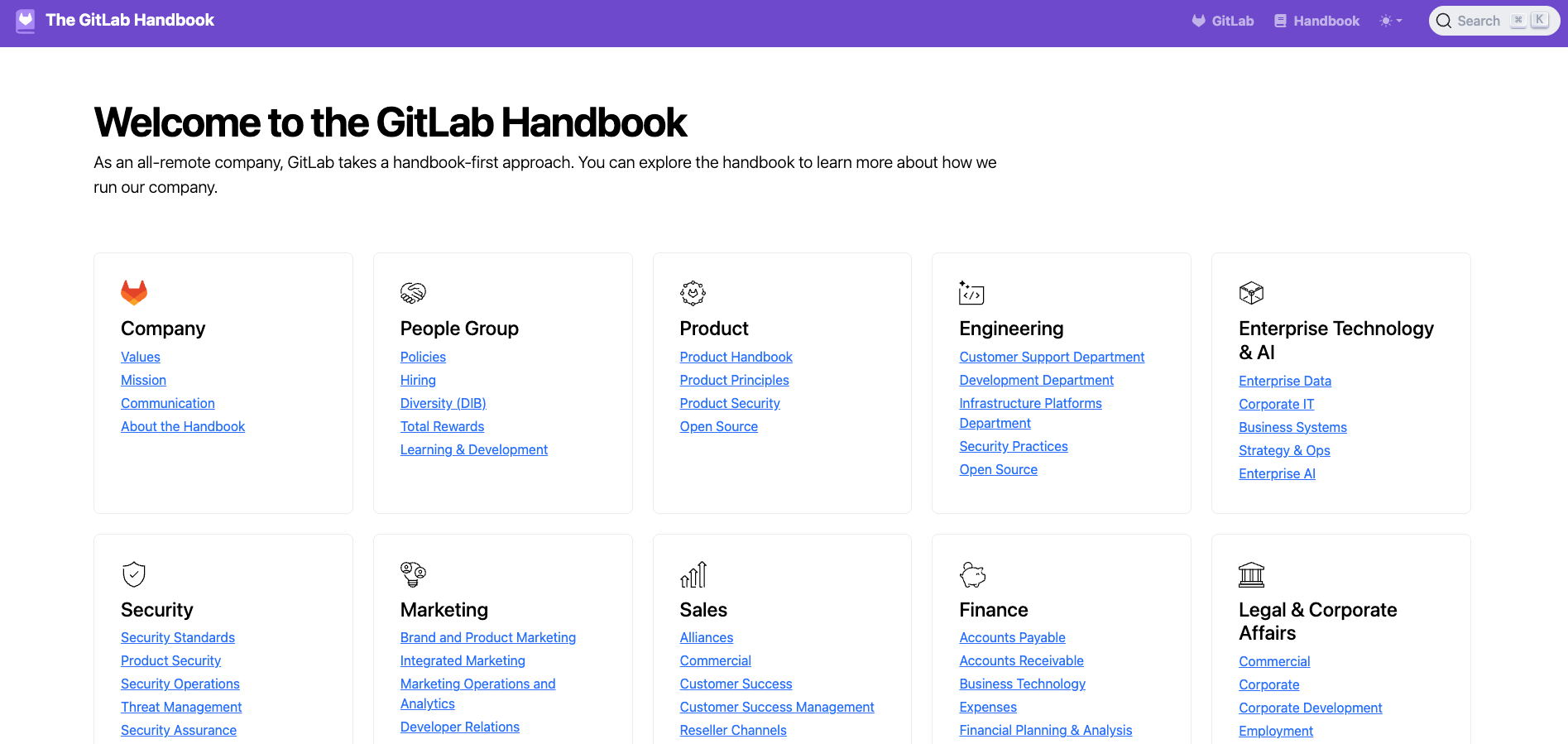
GitLab is probably the most-cited example of a handbook done right.
The company runs an all-remote workforce spread across more than 70 countries, and its public handbook has grown to over 2,700 pages, serving as the single source of truth that lets thousands of employees collaborate asynchronously instead of depending on real-time meetings.
This maps to real headcount and retention numbers, too.
GitLab's workforce grew from 1,629 employees in fiscal year 2022 to a peak of 2,170 in fiscal year 2023, while its global turnover rate steadily dropped from 17% down to 14% over that same period, even as the company scaled its hiring aggressively.
GitLab credits a lot of this to its "handbook-first" habit of documenting decisions and reasoning rather than relying on tribal knowledge.
You can browse the current handbook on their website.
2. 37signals
You don't need GitLab's headcount to make this work.
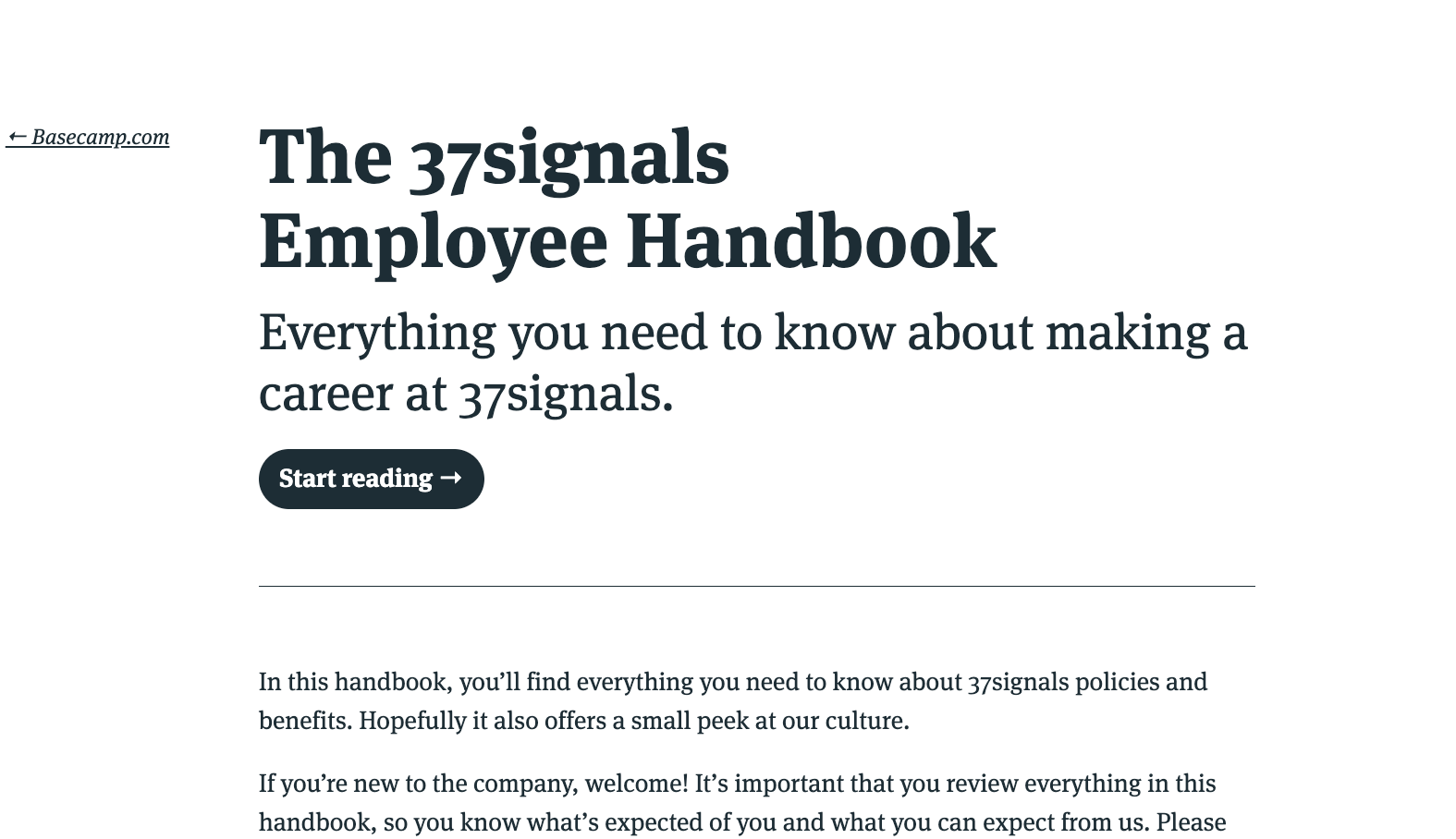
37signals, the company behind Basecamp and HEY, runs a comparatively tiny, fully distributed team and publishes its employee handbook openly.
What's notable here isn't scale, it's structure: every new hire gets a dedicated onboarding project inside Basecamp itself, paired with both a manager and a separate "buddy" from outside their immediate team whose job in the first few weeks is to answer the questions that feel too small to bring to a manager.
Formal check-ins happen at the 3-month, 6-month, and 1-year marks, with performance expectations shared upfront rather than sprung on people later.
The company is regularly held up alongside GitLab and HubSpot as proof that a public handbook doubles as a recruiting filter, since candidates can read the culture and expectations before they ever apply, which tends to attract people who are already aligned with how the company operates.
3. Buffer
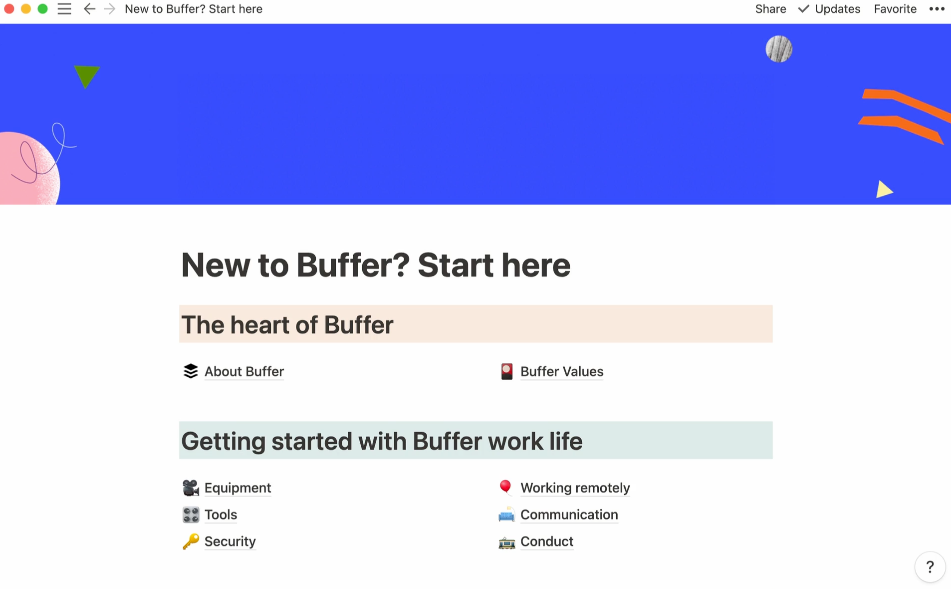
Buffer is a small company, with 73 team members as of the period covered in its 2024 compensation report, and instead of a locked-down PDF, it runs its entire employee handbook as a Notion site that documents everything.
Buffer built this handbook out with Notion specifically because the company operates as a fully remote team and needed a digital headquarters that lets a distributed workforce build and reference company knowledge collaboratively rather than over scattered documents and email threads.
The Notion handbook lays out Buffer's leveling framework, complete with the two-step progression system employees move through within each level, plus the equity compensation structure, including evergreen grants issued at set tenure milestones to encourage people to stick around.
The transparency baked into Notion’s handbook is tied to real, measurable outcomes.
None of this lives in a static document nobody reads twice, it's a living Notion workspace that employees can check whenever they want.
TL;DR
Building an employee handbook fast doesn't mean building it recklessly.
You must be disciplined about where you spend your time: nail the legally required foundation first, lean on a template for the boilerplate, customize based on the real questions your team asks, and fold it directly into onboarding so it earns its keep from day one.
Add the 2026-specific pieces around AI and wellbeing, get sign-off through a tight parallel review instead of a slow sequential one, and roll it out with enough fanfare that people actually read it.
Do that, and you'll have a handbook that protects your business, supports your people, and doesn't cost you three months of your life to produce.