
 Follow us on LinkedIn
The role of people operations (people ops) has grown far beyond the traditional functions of HR.
It’s about strategy and shaping culture, driving performance, and building workplaces where people genuinely want to contribute.
What is people operations?
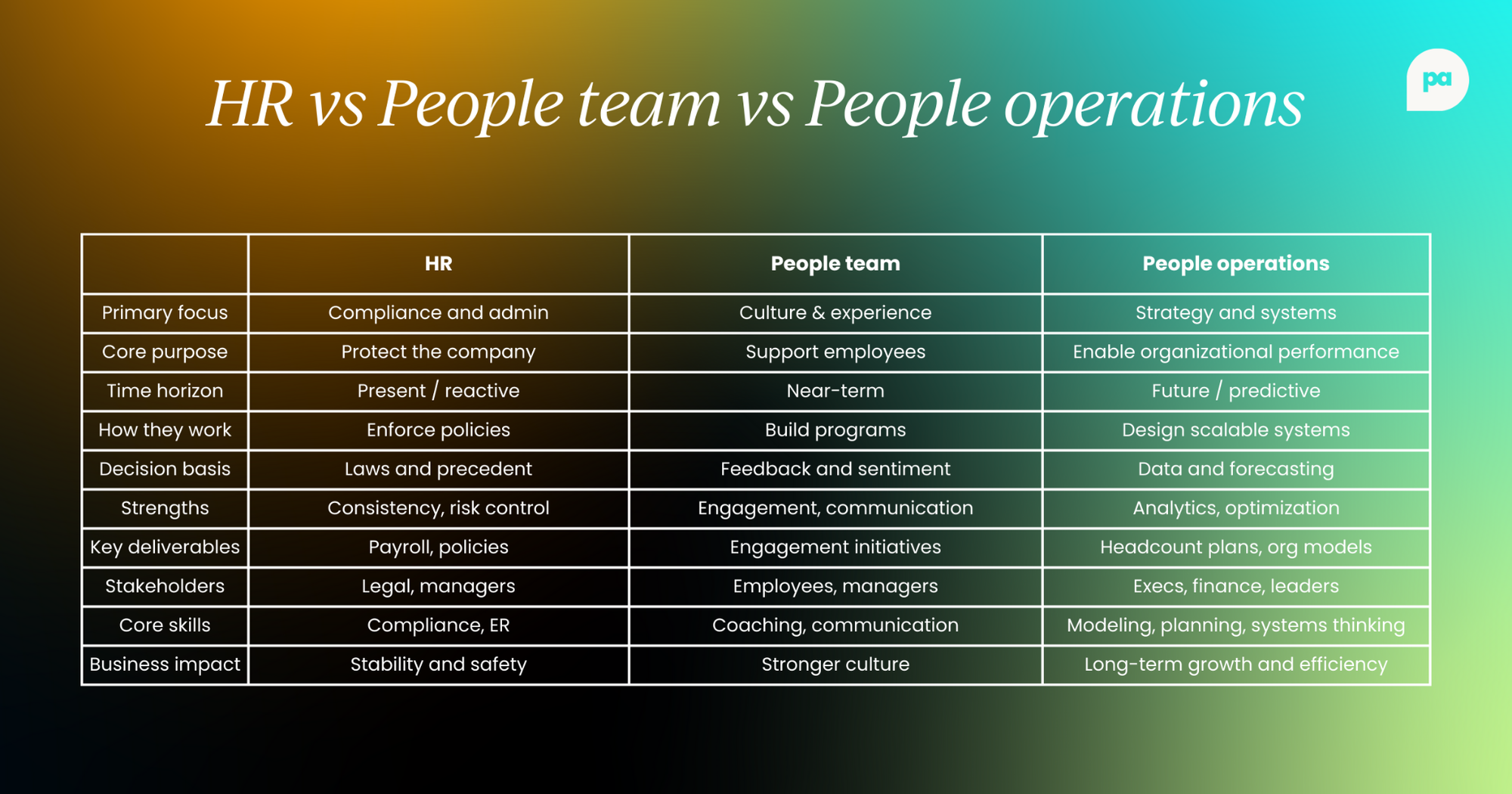
People operations is a data-driven, forward-looking sub-function of the People team, serving as the operational engine behind organizational effectiveness.
This means it creates systems to support employees while also informing finance, executives, and department leaders about future workforce needs, often working one to two quarters ahead.
This isn’t a support function either. People operations is a predictive, analytical discipline that helps organizations perform at their highest potential.
So, people ops handles things like:
- Workforce planning and management
- Analytics and predictive analytics
- Systems design (to enable performance)
- Generational planning
- Benchmarking
- Progression modeling
- Headcount/promotion rates prediction
- Cost forecasting
The evolution of people operations
People operations emerged as a response to the limitations of traditional HR.
For decades, HR functioned primarily as an administrative and compliance-focused department, handling payroll, enforcing policy, and mitigating risk.
This model worked in the industrial era, when companies relied on standardized labor and hierarchical structures.
But as work shifted toward creativity, autonomy, and knowledge-based productivity, companies needed a different approach.
The turning point came in the early 2000s when Google popularized the concept of “people operations.”
Under the leadership of Laszlo Bock, Google introduced practices that treated people decisions with the same rigor as product or financial decisions.
Instead of relying on intuition or tradition, people ops used experimentation, behavioral science, and analytics to understand what actually drives performance and engagement.
This marked a significant philosophical shift:
- From compliance → strategy
- From enforcing rules → optimizing systems
- From managing people → empowering people
- From reactive problem-solving → proactive forecasting
Modern companies adopted this approach because they realized talent is a competitive advantage. People operations became the function responsible for designing the systems, insights, and structures that support scalable growth.
As a result, many companies began rebranding HR to People teams, People Ops, or People & Culture.
The goal is to signal a shift from transactional administration to strategic partnership, and from command-and-control management to an employee-centric, data-informed approach.
Core competencies of people operations
As people ops becomes more strategic and analytical, the skillset required to excel in these roles has changed significantly:
Systems thinking
As a people operations professional, you must see the organization as a network of interconnected systems (roles, incentives, workflows, structures, culture, tools) and design them to work in harmony.
Systems thinking helps identify root causes, not symptoms.
Data literacy and analytical modeling
Modern workforce planning requires more than intuition.
People ops rely on dashboards, forecasting models, scenario planning, and predictive analytics.
This includes interpreting data, challenging assumptions, and translating insights into actionable recommendations.
Stakeholder management
People ops collaborates with finance, operations, department leaders, and executives.
Strong written and verbal communication, expectation-setting, and relationship-building are essential for influencing decisions and aligning teams.
Change management
Companies are constantly evolving: new tools, reorgs, restructuring, policy updates.
People ops leads the rollout of changes by preparing leaders, enabling communication, and ensuring adoption across the company.
Organizational design knowledge
People operations shapes team structures, reporting lines, span-of-control models, and capacity planning.
This requires an understanding of how organizational architecture impacts performance, speed, decision-making, and employee satisfaction.
Tech stack fluency
People operations teams rely heavily on tools like HRIS systems, ATS platforms, engagement tools, and BI dashboards.
Knowing how systems integrate, where data flows, and how to automate workflows is now a core competency.
A data-driven foundation
People operations relies on clean, reliable, and integrated datasets to analyze workforce dynamics, predict trends, and identify opportunities for improvement.
Instead of using anecdotal insights or one-off manager requests, people operations uses evidence-based forecasting to shape workforce planning.
This approach touches every part of the employee experience. For example:
- Attrition patterns show which departments might struggle in the coming quarters.
- Promotion velocity shows whether internal mobility is healthy or stagnating.
- Skills data highlights where your organization may need to invest in training or hiring.
- Compensation analytics uncover whether pay practices remain equitable and competitive.
With these insights, you can build models that help leaders in your company understand not only what is happening now, but what’s likely to happen next.
Proactive workforce planning
“Workforce planning is a core business process that aligns changing organizational needs with people strategy. It can be the most effective activity an organization can engage in. It doesn’t need to be complicated and can be adjusted to suit the size and maturity of any organization.
“It can provide market and industry intelligence to help organizations focus on a range of challenges and issues, and prepare for initiatives to support longer-term business goals.” – CIPD
Instead of waiting for managers to ask for more headcount or scrambling when turnover suddenly spikes, people ops teams take a proactive approach.
They map out staffing needs for the coming quarters so the company always has a clear picture of what hiring or training will be required.
For example, in a people operations role, you might build long-term headcount forecasts that factor in projected attrition, past hiring trends, business growth, operational priorities, and upcoming promotion cycles.
These forecasts help the company prepare for expansion before it happens.
Planning ahead also helps avoid the costly ripple effects of reactive hiring; things like rushed onboarding, unclear role expectations, or preventable talent gaps.
Effective workforce planning also involves anticipating budget needs. That’s why people ops often partners closely with finance to model hiring costs, salary increases, L&D investments, and manager capacity.
This collaboration ensures leaders always have accurate, defensible plans for how the company will invest in its talent.
However, a McKinsey & Company report found that, while 73% of surveyed organizations conduct full operational workforce planning, only 12% of U.S. HR leaders say they do strategic workforce planning with at least a three-year focus.
One study by Aptitude Research highlights the importance of this.
Generational planning and benchmarking
Generational planning has become a key element of people operations as workforces become more diverse and multigenerational overall.
This is because you analyze demographic patterns, tenure data, leadership readiness, and progression timelines to anticipate how the workforce will evolve over time.
Understanding when senior leaders may retire, how quickly early-career talent will progress, and what skills will be in highest demand allows you to design systems that prepare the company for the future.
Benchmarking adds an external layer of insight. People ops relies on market comparisons to assess whether:
- Compensation is competitive,
- The company is promoting at a healthy pace,
- Team structures are efficient, and
- Performance expectations align with industry standards.
Benchmarking ensures that the company is never surprised by talent market shifts, competitor pay increases, or changes in candidate expectations.
Through generational planning and benchmarking, People Operations helps organizations maintain a competitive edge and develop a resilient, future-ready workforce.
 Teresa Garanhel
Progression modeling and internal mobility
People operations plays a central role in defining how employees grow within an organization.
Progression modeling (a.k.a., the creation of structured pathways for career growth) helps employees understand what advancement looks like and what skills or achievements are required to move forward.
This clarity leads to trust, reduces ambiguity, and makes growth feel attainable and fair.
As people ops, you build competency frameworks, leveling structures, and promotion criteria that align with organizational goals.
These systems prevent arbitrary decision-making and help ensure that promotions happen consistently across teams and departments.
Internal mobility relies heavily on these systems. When your employees can see a clear path forward, they stay longer, develop deeper expertise, and contribute more meaningfully to the company’s goals.
Strong progression modeling is one of the most powerful tools people ops has for improving engagement, retention, and long-term workforce stability.
People operations as a strategic business partner
People operations is now a central strategic partner in many organizations.
Instead of functioning as an administrative support department, people ops works side-by-side with executives to:
- Design the workforce of the future,
- Anticipate challenges,
- Strengthen leadership pipelines, and
- Ensure the organization can meet its long-term goals.
This deep integration with business strategy makes this an essential function for growth-oriented, forward-thinking companies.
It’s important to remember that its influence goes beyond hiring and retention, as it extends to financial planning, culture design, and long-term organizational development.
TL;DR
People operations is a data-driven, predictive, and highly strategic discipline that ensures organizations have the clarity, structure, and insight they need to perform at their best.
By operating one to two quarters ahead, people ops connects people strategy with business strategy, enabling smarter decisions, more accurate forecasts, and more sustainable growth.
Join our (free) Insider membership for exclusive content and HR templates designed to make your day-to-day 1,000x easier.
 People Alliance