
 Follow us on LinkedIn
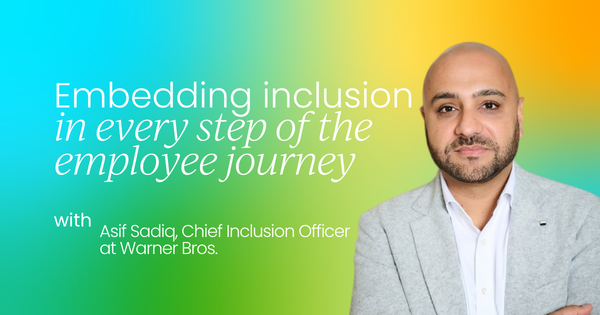
I want to spend some time sharing my thoughts with you on the future of inclusion and how we truly embed it within an organization.
Some of what I say you'll agree with. Some of it you might not. That's the beauty of diversity.
We don't have to all think the same, but we can still come together to produce exceptional results in what we do.
Before I get into the employee life cycle and what I think we need to do differently, I want to start by talking about where I think the real gaps are.
This isn't meant to be a lesson on what diversity and inclusion is. It's an invitation to think about these concepts for the future, rather than through the lens that has been applied in the past, a lens that has caused real challenges and a lack of understanding.
 Sabrinthia Donnelly
Diversity is not a single box
Whenever I mention diversity, people often think of it as a singular dimension: race and ethnicity, gender, sexual orientation, disability, and so on. The truth is, no one is a single element of diversity. None of us are.
Throughout our lives, what matters to us evolves based on what we go through and the events that shape us.
It is really important that when we think about our employees, our staff, the people we engage with, we don't see them in a box. We see them beyond the box, beyond the one element.
Let me give you a personal example. People often talk to me about my race and ethnicity, in the UK described as someone from an ethnic minority background, in the US as a person of color.
You'll all be pleased to know that the color of my skin has remained the same for forty six odd years, and I've learned to navigate my race pretty well.
There are moments in my life when race brings challenges, but some of the bigger challenges I face come from the fact that I'm getting older, and with age, I'm inheriting disabilities.
I'm a dad to two young kids, and I'm trying to be an active dad, and that's a really important part of my diversity too. I am a person of faith, so at different times of the year, different events matter deeply to me.
 Sabrinthia Donnelly
I say all this because if you go onto any company's HR system and only look at the box, you'll never know any of that. You'll never know the richness of my authentic, unique identity. We must move beyond the singular dimensions.
We must also think about neurodiversity: dyslexia, dyspraxia, autism, and so on. Many companies have started to see the power in people who think differently and bring a different perspective, and that's where we need to be.
This isn't about people we need to help or people who need extra access.
It's about recognizing that because they think differently, they bring different perspectives, different ideas, and different ways of problem solving. All the great things we aspire to achieve as organizations come through having that diversity of thought.
Then there's age diversity, up to five generations in the modern workplace today. How inclusive are we of each one of those generations? Do we focus just on Gen Z, or on every single generation?
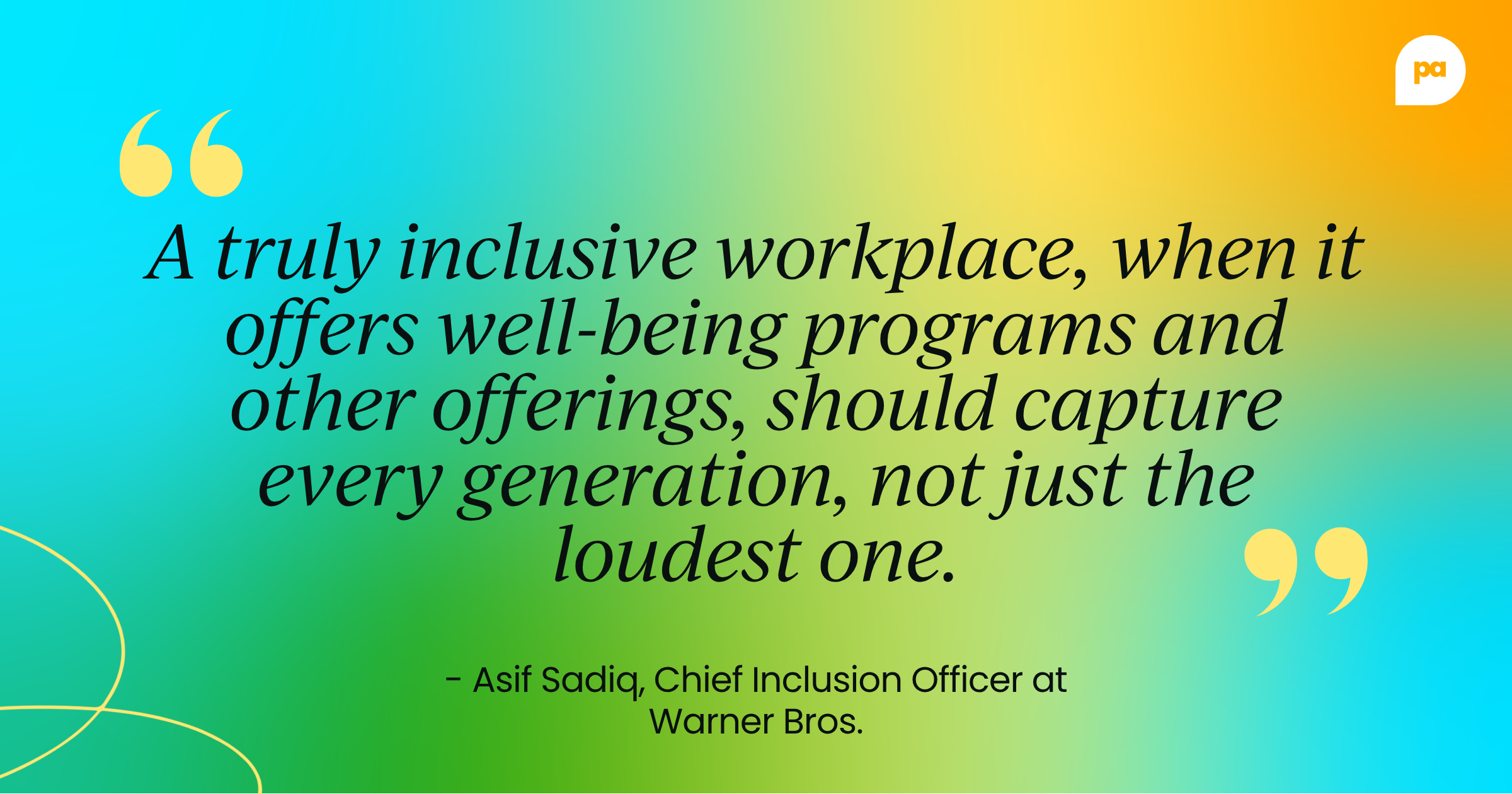
A truly inclusive workplace, when it offers well-being programs and other offerings, should capture every generation, not just the loudest one.
Finally, when we think about diversity, it isn't about one group over another or preferential treatment for one. It is about each and every person.
Every person will fit into an element of diversity at some point in their life, whether that's age, disability, or gender. We will all be there. So it is never about one group over another. It is about every single person.
Inclusion alone doesn't drive change
Inclusion is great, but by itself it doesn't drive change. We need to move beyond it.
Let me give you an example. Say we have a team that's predominantly men, and a woman joins the team. Now you've got diversity from a gender perspective, and you've got inclusion. She's part of the team.
But unless she has psychological safety and trust, unless she can give a different opinion without repercussions, we're defeating the purpose of that diversity.
It looks good on paper. We can showcase that we've got gender diversity. But we're not truly achieving business success.
The true success of businesses, and this isn't me saying it, there's research that shows that when people don't just feel included but feel they belong, there's three and a half times more productivity, more innovation, more creativity, and better problem solving.
All the great things we aspire to achieve are achieved through creating a sense of belonging. Belonging isn't a new concept. Each of us has belonged somewhere at some point, whether to a group of friends or a sports team.
When we belong, we're not worried. We're not masking who we are. We're not code switching. We don't have impostor syndrome. We can just be ourselves.
That's what we need to create in our workplaces: environments where people can be themselves and bring their true skills into the workplace, rather than feeling that to succeed, they have to be like everyone else.
Why the employee life cycle matters
So why is the employee life cycle important, and how do we embed inclusion for the future? The employee life cycle covers attraction, recruitment, retention, development, progression, and exit.
If we're truly going to create workplaces with that inclusive mindset and that sense of belonging, we need to impact every one of those areas.
And when I say impact, I don't mean traditional measurements of how many people we have from this background or that one.
I mean auditing the processes to make sure they are fair. Because at the end of the day, this isn't about giving preferential treatment to one group over another. It's about ensuring every single person gets to the start line. Whoever wins the race after that is the person we hire.
But we know that historically, not everyone manages to get to that start line, and that's where a lot of our efforts need to focus.
When we look at recruitment, is the answer really to spend another hundred thousand dollars on a job ad, or is something in the process broken?
Are we attracting people from different backgrounds, only for them to drop off at certain stages? Is it hiring managers? Are we getting a good mix of people who represent our communities, only to lose them at the point of hiring decisions?
If that's the case, we don't need another hundred thousand dollars on another job ad.
What we need is training for our hiring managers to help them understand how to look beyond people who they perceive as similar to themselves. We need to break down our processes to truly understand where the gaps are.
And our job isn't done once someone is hired. Over the years, I've seen so many organizations talk about how important diversity and inclusion are to them, how great their culture is, how much the company believes in it, and then once someone finishes onboarding, that's it.
The truth is, we need to focus on inclusion throughout someone's career if we're truly going to impact it and get the best out of them. Our work really starts when someone joins us. That's when the work begins.
Rethinking progression and development
When it comes to progression, I've heard many organizations talk about development programs for specific groups.
I personally don't believe in them, and I want to be clear there isn't a right or wrong answer here for those who do run them. What I think matters is that our mainstream programs, whichever ones we run, are genuinely accessible to every single person.
Sometimes, with good intent, when we create additional programs, all we're doing is adding another barrier that someone from an underrepresented group has to clear before they can get onto the main program.
We need to focus on the main program and ask whether it's truly representative, whether everyone has an equal, fair opportunity to get onto it.
We also have to move beyond some of our assumptions in these development programs. I've seen many leadership programs talk about needing leaders who are strong, leaders who have all the answers. We don't.
The truth is, the future of leadership is about leaders who show vulnerability, who show a human side, human centric leadership, leaders who can be authentic in the workplace. That's what people are looking for.
We need to design these programs without a narrow, perfect view of what a leader or an individual should look like in order to get promoted. Let's design for a wider spectrum, because the future isn't about people who think one way.
We need a vast range of people with different ways of thinking, different ways of problem solving, and different ways of showing up.
Then there are our actual processes. How fair are they, really? I know we all try to build systems that are fair, but what about the informal processes?
We all know there are certain people whose names are already being mentioned in rooms, and certain groups whose names aren't.
Research from universities like Oxford and Harvard shows that women and those from underrepresented backgrounds are often over-mentored and under-sponsored.
Everyone mentors them, but no one is vouching for them when they're not in the room. No one is thinking of them for the next big project. So how do we create more equity in those informal processes to make sure everyone truly has access?
 Sabrinthia Donnelly
Exits, boomerangs, and the small things that matter
After progression, we also have to think about exit. When a staff member or colleague says they're leaving, it can feel like the end of the world. The truth is, people boomerang back.
Different generations won't stay in the workplace as long as previous ones did, and that's simply the reality of today's workforce.
How do we celebrate people so they leave with a positive, inclusive experience, one they'll go and share with others, because there's no better attraction tool for future talent than word of mouth?
And how do we make sure that if that person goes elsewhere, picks up new skills, and eventually wants to come back, they actually will? They'll only come back if their experience with us was a positive one, if they felt truly included and truly part of the organization.
People often ask me what the solution is, what the big program should be. I promise you, it isn't about how many millions of dollars we spend in this space. It's the small things we do that drive change.
Is there a perfect solution? No, there isn't. If there were, we'd have solved some of these challenges a long time ago. What we have to do is try, and when we make mistakes, own up to them and try again. Adjust and try again. But we have to keep working on the small things.
People don't care about the big banners or the big statements a company puts out. What your staff and the individuals on your teams care about is whether they feel included when they turn up and work within their team.
Do they feel they can be themselves? Do they feel they have an equal, fair opportunity at work and at promotion? That's what people care about, and the change required there doesn't come from company statements.
It comes from what line managers do. It comes from what colleagues do. It's the small things: saying hi to someone you've never said hi to, sitting next to someone in the office you've never sat next to, speaking up for someone when they're not in the room.
It's those small acts of inclusion that truly drive cultural change and embed inclusive behavior.
 Teresa Garanhel
Embedding inclusion, not bolting it on
Inclusion can't work as a standalone objective. It has to be championed and embedded into our systems, into the things we do, into our leadership behavior.
How do we get leaders to think about inclusion not five minutes before a meeting or five minutes after, but to truly build it into the way they work, so it isn't an afterthought or a nice statement, but something embedded into how they think?
People often ask me how we challenge our biases. My honest answer is, there are too many, and we're all biased. What we need to do instead is start being consciously inclusive.
That means, before we make decisions, spending ten seconds thinking about the decision we're about to make. Does it have a negative impact on anyone? Is it inclusive?
When we make that a habit, it becomes natural, and it gets woven into everything we do. That's how we make inclusion sustainable, in a way that truly drives change.
 Teresa Garanhel
We also need to ask whether we measure our programs and initiatives, and whether we check if they're actually what our people want.
When we've sent staff from specific groups on development programs, what have we done afterward? Have they simply been told to go back to their desk and carry on as before?
That doesn't really help them or us. We need to keep focusing on where our systems are broken and what we can do within our mainstream initiatives to genuinely drive change and create an inclusive outcome.
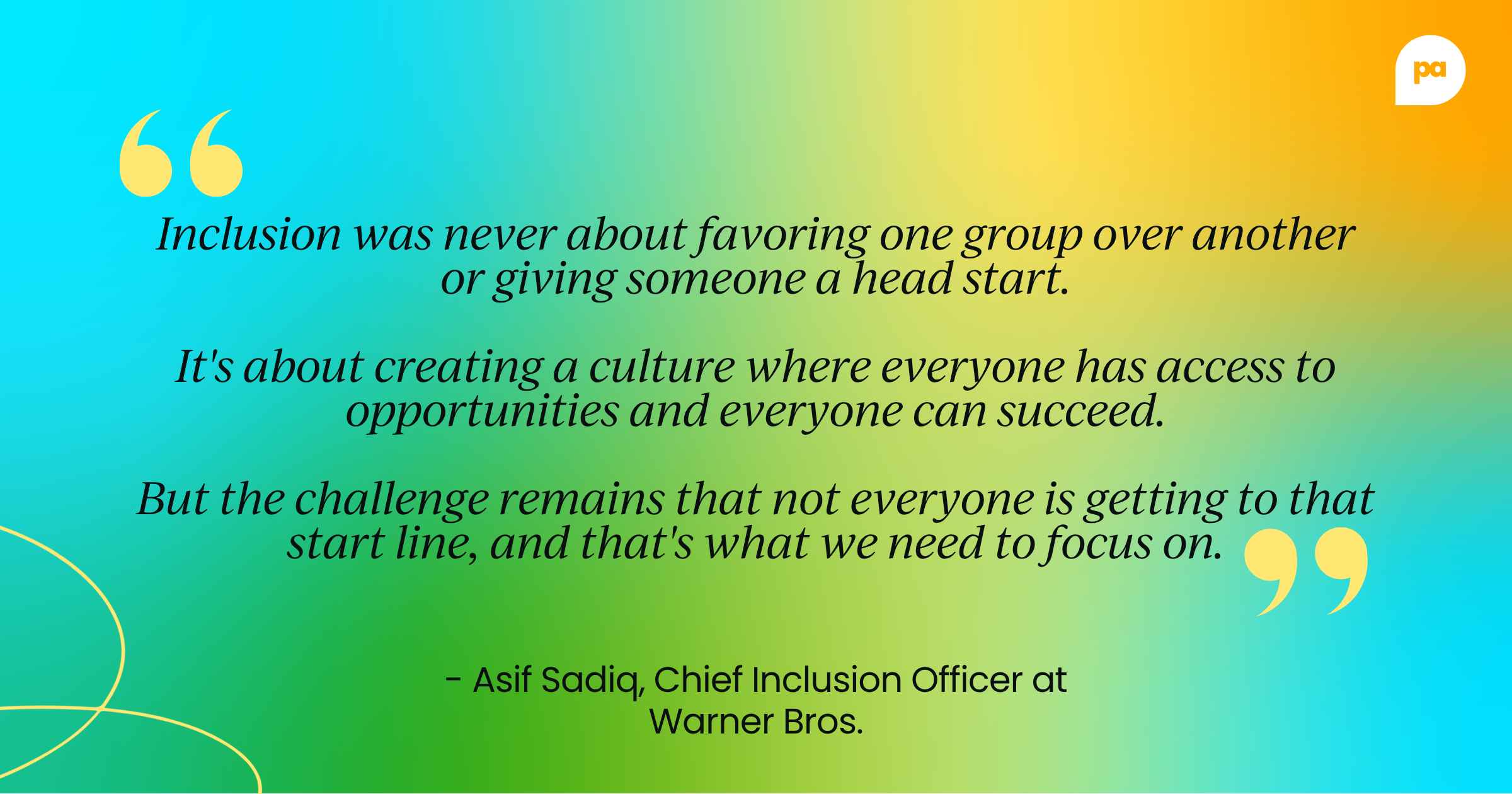
As I said at the start, this was never about favoring one group over another or giving someone a head start. It's about creating a culture where everyone has access to opportunities and everyone can succeed.
But the challenge remains that not everyone is getting to that start line, and that's what we need to focus on.
Let's not try to predetermine outcomes. Let's make sure everyone gets to the start line, whether that's our recruitment process, our promotion process, or our development opportunities, so they have a fair chance.
Because at the end of the day, we will always hire the best people. And let's think not just about who is a cultural fit for our organizations, but who is a cultural add, who brings a different perspective and adds to our culture.
As our products and services become more globally connected, how ready are we to engage with global audiences?
A global view of inclusion
I'll end on this point. Diversity will look different in every country, region, and market. But the feeling of inclusion is the same everywhere.
Let's acknowledge that, and let's not take one perspective on diversity and try to roll it out globally across our organizations, because different markets and regions are different.
Let's also be careful not to view things only through a dominant cultural lens. We all have a tendency to see the world through our own perspective, through our own dominant culture, whatever that might be.
The question is how we meet people halfway. It's not about one culture being right and another being wrong. It's about creating environments where we can respect our differences.
As I said at the start, diversity isn't about agreeing. We don't have to agree on everything. But we can still come together to produce exceptional results, and that healthy disagreement is a good thing.
It challenges patterns. It breaks systems that have been around for a long time and that don't produce the results we need.
The journey to embedding true inclusion runs across everything we do. We must impact every part of the employee life cycle, from attraction and recruitment to retention, development, and progression, not by bolting on another program, but by auditing our systems and processes to find where the gaps really are.
What can we do to drive change? What areas can we truly impact? And how does every person in our organization understand their own responsibility in this? Inclusion doesn't sit with your inclusion department or your leadership team alone.
It is each and every person's responsibility to drive that change, because we want to create environments where everyone flourishes and everyone has opportunities.
So the real question is how we make sure everyone understands that. And the answer is by embedding it within our processes, so it isn't a nice to have, an add-on, or a fluffy extra. It is who we are, and it is what our culture is.
Become an Insider member (free) to get access to exclusive content and insights from top people leaders who've walked the walk.
 People Alliance