
 Follow us on LinkedIn
Rolling out an employee recognition program sounds like one of the easier wins on a people leader's plate. Everyone likes being told they did a good job, right?
But a recognition program built without fairness baked in from day one can actually damage morale.
You end up with the same five loud extroverts getting shoutouts every month while your quiet, steady performers watch from the sidelines wondering why their work doesn't count.
That gap between "recognition matters" and "recognition happens fairly" is exactly where a lot of well-intentioned programs fall apart.
“When you've got great work also happening at the seven and eight level, or even the six and seven level, beware of comparing apples to apples... it's an apples to oranges type thing.
“If Bob and Mary are standing right next to each other, recognize Mary for the great work she is doing based on her benchmark, not based on what Bob has done, because he's been here for fifteen years, and he's Harvard educated.” – Jeff Birk, Global GTM & Revenue Enablement Leader
Why fairness has to come before features
It's tempting to start planning a recognition program by picking a platform, a budget, and a handful of reward tiers. That's backwards, as features and budgets are the easy part.
Fairness is the part that determines whether your program actually works or just becomes another line item employees roll their eyes at.
Think about what happens when recognition feels arbitrary. People start keeping a mental tally. They notice that Dave in sales gets a shoutout every other week while the ops team, who quietly keeps the lights on, barely gets a mention.
Once employees conclude that recognition depends on visibility or personality rather than actual contribution, the whole program loses credibility fast, and no amount of gift cards will win that trust back.
The research backs this up. Even though 94% of organizations have some kind of recognition program in place, only 31% of them rate their program's effectiveness as high or very high, with cost and inconsistent application among the biggest culprits.
That inconsistency is almost always a fairness problem hiding in plain sight. A program that looks great on paper but plays favorites in practice will underperform no matter how much you spend on it.
 Teresa Garanhel
Define what "fair" actually means for your organization
Here's where a lot of people leaders trip up: they assume fairness is self-explanatory. It isn't.
Fairness in a recognition program usually breaks down into three separate ideas, and you need to decide upfront which ones matter most to your culture.
- First, there's procedural fairness: are the rules for who gets recognized and how clear, consistent, and applied the same way across every team?
- Second, there's distributive fairness: does recognition actually spread across departments, tenure levels, shifts, and demographics, or does it cluster around a few visible roles?
- Third, there's interactional fairness: do people feel respected and heard in how recognition is delivered, not just whether it happens at all?
Write these definitions down and put them in the program charter. If you skip this step, every manager on your team will invent their own definition of fair, and you'll end up with as many interpretations as you have managers.
 Teresa Garanhel
Build recognition criteria before you build the program
Good criteria describe behaviors and outcomes, not personality traits.
"Consistently mentors new hires" works as a criterion. "Great attitude" doesn't, because it's vague enough to mean whatever the person nominating wants it to mean.
The same logic that governs fair hiring and promotion decisions applies here: adding structure closes the door on bias.
Organizational research on decision-making has repeatedly found that when advancement decisions rest on defined competencies and measurable outcomes rather than gut feel, employees report noticeably more confidence that the process is being run fairly.
The same principle carries over directly to deciding who gets recognized and why.
It's also worth knowing where most programs currently fall short: industry data shows only 41% of organizations tie nominations to actual results, and the ability to nominate someone is still mostly restricted to managers or peers rather than opened up broadly.
That narrows the field considerably and raises the odds that recognition tracks relationships rather than results. Widening who can nominate, and anchoring every nomination to something specific and verifiable, is a fairly quick fix.
"The number one complaint is for managers about why they don't do recognition. I'm afraid that I'm gonna be accused of playing favorites... performance based is very important because that will get rid of any hints of bias or favoritism." – Jeff Birk
Open up who can give and receive recognition
A recognition program where employees only receive feedback from managers is unfair by design, simply because it depends entirely on how much visibility any one manager has into everyone's daily work.
Managers naturally notice more of what happens right next to them. That means employees on hybrid schedules, remote teams, or roles with less manager face time might get overlooked without anyone intending it.
Peer-to-peer recognition fixes a lot of this on its own.
It spreads the job of noticing good work across an entire team instead of resting it on one person's shoulders, and coworkers often catch the small, unglamorous wins a manager would never see.
Remote and distributed teams deserve extra thought here too.
Recent workforce data shows distributed employees feel meaningfully less appreciated than their office-based counterparts, roughly a fifth less, which makes asynchronous, time-zone-friendly recognition a baseline requirement rather than a nice extra for remote-first companies.
If your program quietly assumes everyone's sitting in the same building at the same hour, you've already built an unfairness problem into the design before launch day.
Protect the program from legal and compliance risk
This is the part that gets skipped most often, and it's the part that can turn a well-meaning program into a genuine liability.
Recognition programs sit closer to compensation and total rewards than most people realize, which means the guardrails around fair treatment in employment decisions apply here too.
The legal landscape around workplace fairness initiatives has shifted considerably over the past year and a half.
Following recent federal executive actions, employers have had to revisit how they frame inclusion-related programs, recognition included, so they stay on the right side of anti-discrimination law.
Guidance in this space consistently points out that any program tied to identity characteristics, rather than job-relevant behavior, carries real legal exposure, even while broader efforts around inclusive culture and bias reduction remain perfectly fine.
The encouraging part is that legal safety and program fairness point in the same direction.
Practices considered legally sound, things like structured criteria, objective scoring, and eligibility open to every employee, are the exact same practices that make a program feel fair on the ground, while numeric targets tied to protected characteristics remain risky territory.
Have legal or compliance review your criteria language before launch, especially if you operate across multiple states or countries with different rules.
 Teresa Garanhel
Track the data, not just the vibes
"Data-driven coaching, going off of objective fact as opposed to intuition... it's hard to get buy-in off of a feeling." – Alexandra Blanco, VP of Sales Enablement & Founder of Rayna Social Club
You can't manage fairness you're not measuring. A lot of recognition programs launch with good intentions and then never look back at who's actually receiving recognition, how often, or from whom.
Six months in, someone finally pulls a report and discovers one department has received triple the recognition of another, or that rates skew heavily by tenure, gender, or job type.
Build measurement into the program from day one. Track how often recognition happens by department, by manager, by tenure, and where you can, by demographic group, so patterns surface before they harden into a real problem.
Companies that treat recognition as a strategic function tend to monitor both the volume and the source of recognition, whether it's coming from managers or from peers, and feed those insights back to leadership regularly.
This isn't busywork. It's the mechanism that keeps a program honest over time, since informal bias tends to creep back in quietly the moment nobody's watching the numbers.
Regular review matters just as much as the initial data collection. Industry surveys show only 43% of organizations formally review how well their recognition program is working
Even fewer take employee feedback seriously when they do, which points to a broader tendency to launch a program and then go quiet on it instead of staying proactive.
Set a quarterly review cadence from the start, and treat it as a fixed commitment, not something you'll get to eventually.
 Teresa Garanhel
Make recognition specific, personal, and consistent
"Every week, I want you to have a goal to give, receive, or observe recognition... When do Olympic athletes get their medals? Right after they climb out of the pool... there is no wasted time." – Jeff Birk
Fairness isn't only about who gets recognized, it's also about the quality and consistency of how that recognition gets delivered once someone earns it.
A generic "great job, everyone" message sent equally to a whole team might look fair on the surface, but it actually undercuts the entire point, since it fails to name what anyone specifically did.
Employees increasingly expect recognition to point to real, specific impact rather than sit at the level of vague praise.
Frequency is just as important as substance here. Current workforce data shows only about 17% of employees say they're recognized on a weekly basis, even though those who do receive regular, meaningful recognition report a far stronger sense of belonging and describe themselves as performing at their best more than twice as often.
Consistency across teams matters as well. If one manager praises their team weekly and another does it twice a year, that gap is a fairness issue even when both are technically following the same program.
Additionally, survey data shows a majority of employees actually prefer non-monetary recognition, things like a handwritten note, public praise, or a plain verbal thank you, and preferences shift by demographic, with women somewhat more likely than average to favor written appreciation.
Give people some say in how they'd rather be recognized: public shoutout, private note, or tangible reward, for example.
This respects the fact that appreciation lands differently person to person, and that's part of fairness too.
 Nick Holmes
Train managers before you flip the switch
None of the structure above matters much if the managers actually giving out recognition haven't been trained to apply it consistently.
Managers are the front line of your program, and left to their own interpretation, you'll end up with as many versions of "fair" as you have managers on the payroll.
Manager training needs to cover the specific criteria, the common bias traps, like favoring whoever's easiest to talk to, and practical steps for making sure quieter, remote, or lower-visibility employees don't slip through the cracks.
You can have a short, practical session before launch, paired with a simple checklist managers can reference before nominating someone.
Leadership visibility matters here as well. When leaders visibly take part themselves, everyone else tends to follow.
Data on platform adoption shows employees are roughly twice as likely to engage consistently with a recognition tool when they see peers and leaders using it regularly, and organizations that designate recognition champions see stronger participation and better outcomes overall.
If your leadership team doesn't buy in visibly and early, don't expect the rest of the organization to take the program seriously either.
3 real-world examples to learn from
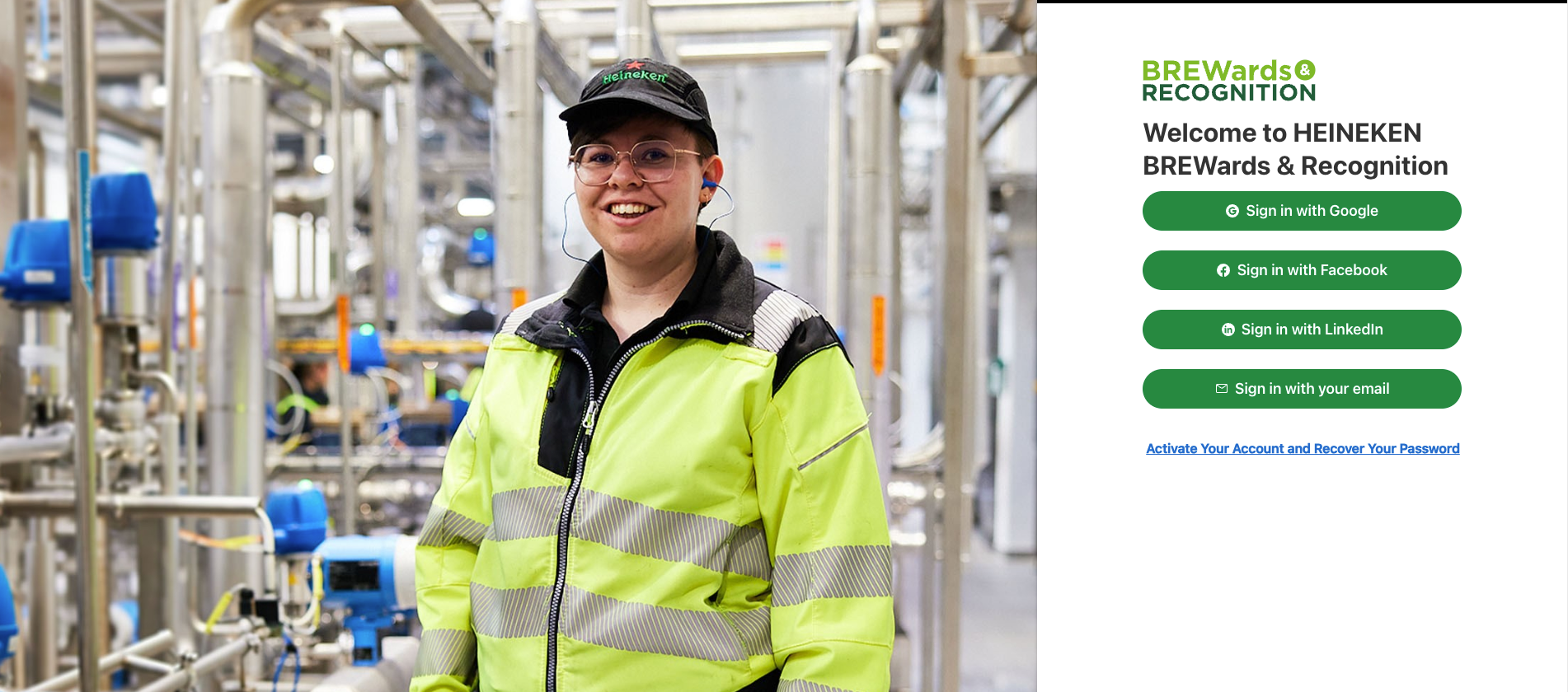
Heineken's BREWards program
Heineken's original recognition scheme, called My Recognition, was quietly failing almost everyone. With a workforce of 2,400 people, the program had only 40 awards worth about $1,400 total to hand out each year, and less than 2% of staff ever received one.
Unsurprisingly, only one in five employees agreed with the statement "I receive recognition when I do a good job" on the company's engagement survey.
Rather than just adding more budget, Heineken's team rebuilt the program around fairness directly.
They pulled feedback from the engagement survey and from a senior leadership group called the People Cabinet, then designed multiple award tiers tied to company values, kept the same per-person budget (roughly $65), and paired local manager discretion with central guidelines so recognition stayed consistent across sites rather than depending on which manager someone happened to have.
They also trained three separate groups (employees, managers, and volunteer “Recognition Champions”) so the criteria were applied the same way everywhere.
Within five months of launch, the company had issued more than 1,300 awards, reaching about 54% of its workforce, a huge jump from the roughly 2% the old program reached.
Their new program is called BREWards.
Capital One's company-wide rollout
Capital One rolled out a recognition program, built on O.C. Tanner's Culture Cloud platform, across its full workforce of roughly 51,000 associates spanning 145 business units.
The scale here is the interesting part: a program that only reached a favored few departments would have been useless at that size, so the design had to work identically whether someone sat in a call center, a tech team, or a regional branch.
The company reports that 75% of associates have received recognition through the program, with more added continuously, and internal leaders have tied the initiative directly to engagement, attrition, and employee net promoter scores.
Bank of Ireland and the shift toward transparent, flexible reward
At a CIPD conference panel on compensating fairly, Bank of Ireland's Head of Group Reward, David Keogh, described moving the bank's reward and recognition system away from years of rigid, state-imposed restrictions toward something more flexible and transparent for employees.
The redesign gave staff far more say in how recognition and benefits actually applied to them, and it landed well: the reward team received an internal group recognition award themselves, and the added flexibility led to 6,500 annual leave days being used in more flexible ways over the year.
Keogh noted that, unlike running a standard bonus scheme, this kind of change actually generated direct, positive feedback from colleagues and line managers, something reward teams don't typically hear.
TL;DR
Launching recognition programs fairly without accidentally building a popularity contest, a legal headache, or a slow-motion trust breakdown are crucial.
Get them right and you make every employee, not just the loudest or most visible ones, feel genuinely seen for the work they put in.
Join our Insider plan (at no cost) for exclusive content and insights from global people leaders.