

 Follow us on LinkedIn
I'm obsessed with how we can make work more remarkable. I genuinely believe that's my purpose for being on the planet.
Work is the thing we do most after sleep, and for far too many people, it sucks. I don't think it has to.
This article is based on Nick's podcast episode, which you can watch in full here:
A squiggly road into people work
My journey into the people profession has been very squiggly. Today I'm the VP of learning culture at Avalere Health, where we partner with the healthcare industry to get care to as many humans as possible.
The quickest way to describe my job is that I look after how people think and feel at work. I grow the business while giving people joy.
I'm also a PhD researcher in HR and organizational behavior at the University of Kent. I'm a dad, a husband, and I'm dyslexic. Before this role, I was head of HR at a tech company in Manchester, and before that, global head of L&D at a tourism retailer.
Before that, I was, quote unquote, a professional actor. I went to film school in Los Angeles, and while trying to make it, I had about a million jobs, from working at Hamleys toy store to being a kids' entertainer.
I promise you, nothing teaches you resilience like being a kids' entertainer.
 Nick Holmes
The moments that changed everything
I don't think you can pinpoint one moment when you fall in love with something. It's like a long-term relationship, built from a series of things over time. But there are definitely inflection points.
I joined a tourism retailer called Magic Memories as a lifeguard, selling photos at the London Aquarium while still going to auditions. Wildly, I turned out to be incredible at sales, probably because acting is basically lying to people.
I was breaking sales records and soon leading 40 people across the aquarium, the Shard, and Shrek's Adventure.
Then I realized I loved this, so I told the retail directors, "Let me teach other people how to do this, because we'll make loads more money."
My first ever training session took place at the London Aquarium with the shark tank as the backdrop. It couldn't have been more metaphorically aligned if I'd tried.
Then came the fork in the road. My agent wanted me to audition for a fringe play in Edinburgh, a role I had a good shot at. At the same time, the company wanted me to open a store in San Francisco.
I asked my agent whether he honestly thought I could make it as an actor. He said no. I'd get some ads and some work, but that was it.
I remember thinking, "Cool. That's really good feedback." It felt like a weight lifted off my shoulders. Letting go of what you think you should be doing and going after what you actually want is one of the most powerful moments you can have.
The second big moment came in 2019, when my daughter was born. It hit me that in 18 or 21 years, she might be working, and I really don't want her work to suck.
I don't want her coming home telling me she had a bad day. And if I don't want that for her, surely it isn't fair for anyone else either.
I didn't know exactly what that meant yet, but it meant something. I started with law, figuring that if I understood the legal bones of how organizations run, maybe I could fix some things, so I did a master's in law at the University of Leicester.
From there, I talked to loads of people in our industry, started keynote speaking, experimented with technology, and was lucky enough to win learning Leader of the Year with the LPI, along with British HR Awards and CIPD awards. Around early 2023, it clicked.
I wanted to make work not suck.
And only this year have I found crystal-clear purpose: culture is the lens through which we can change work forever.
 Teresa Garanhel
Two jobs for every people professional
This isn't a fluffy "let's make culture great" conversation. Every time a chancellor makes tough decisions about cuts and taxes, it's because our economy isn't growing at the rate it could if we unleashed our true potential.
This is fundamentally about how we get more money into people's pockets.
I believe that if you're in a people role, you have two jobs: grow your business and give people joy. It doesn't matter whether you're in talent acquisition, L&D, people ops, or you're a CPO.
You're in a privileged position, and you owe people that. They should leave at five with more energy than they had at nine.
I've felt both sides of this. When your CEO stands up at a town hall and says, "We haven't grown, we're stagnating, we're making cuts," the dread is instant.
Am I going to lose my job? What about my family? Compare that with hearing, "We're growing, and we're going to pay those bonuses."
Growth, or the lack of it, is one of the most powerful emotions you can give people. We need to figure out how to create more of it without relying on luck, which is what a lot of places do.
Why cynics stay cynical
When I talk about making work feel good through culture rather than perks, I meet plenty of cynics. They're some of my favorite humans, because I love people who challenge things.
The problem is that we've been defining culture the wrong way since it was conceived. The traditional version is "the way things are done around here," a set of values, behaviors, and norms.
But people don't connect with values plastered on a wall. Leadership teams change, organizations change, and the culture gets completely rewired while the values stay the same.
 Teresa Garanhel
Some will say culture isn't measurable. The data disagrees. Research by Graham and colleagues surveyed around 1,800 senior executives across North America, and about 90 percent said culture matters, affecting share price, company value, and how investors perceive their firm.
Cynics are cynics because they've been thrown buzzwords like "we're going to change the culture," and then nothing changed on the ground.
So here's my advice to people teams: instead of telling people what you want to do, tell them what you've done. You can't deny facts, figures, and data.
Don't announce that next year there'll be a brand new onboarding experience.
Change it, then say, "Look at our new onboarding and what the 20 people who've been through it are saying." Suddenly, the cynic in the room sees it.
Your culture is alive
The most common mistake I see is treating culture as static. Your culture is alive. It's living, rewiring, purging, and reinforcing everything you do every day.
It's how your organization makes decisions and how it frames failure. Is failure banked and used to fuel growth, or is it punished and swept under the carpet?
Each moment, repeated, reinforces a pattern.
We also treat culture as an HR thing, yet no one can define what their culture is. Ask a room of HR professionals for three words to describe theirs, and you'll be amazed how often you hear "political" and "siloed."
In a siloed culture, people stay in their box and don't rock the boat, and then we say we have a productivity problem. Of course you won't grow if people won't take risks.
Everyone says they want a "high performing culture." I recently asked a CPO to define it. They said it's where everyone does their best. So I asked them to define "best." Two questions stump 90 percent of people.
So redefine culture, make it everyone's responsibility, be crystal clear about it, act on it, and tell people what you've done.
There's no single thing that makes a culture. Consistency of action is what delivers it.
 Erin McAuley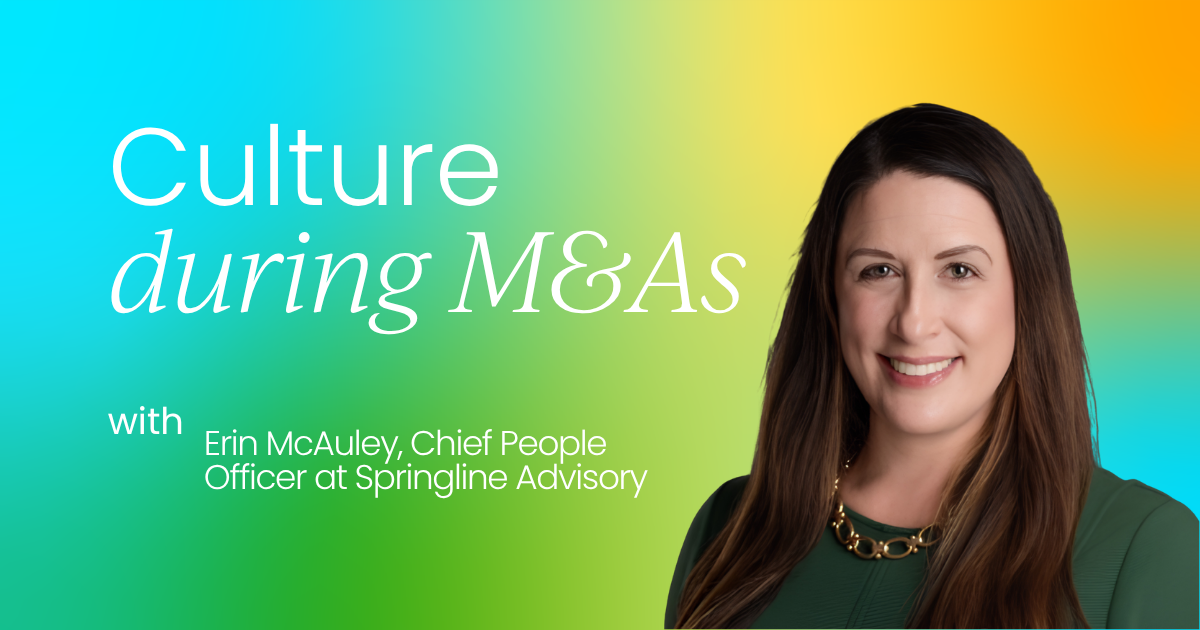
The small things that shape a culture
Some of the most powerful cultural experiences are surprisingly small. Take names. When someone uses your name consistently, you feel trust. If you're a leader, never say, "I'm really bad with names."
I used to fall into that trap. Learn people's names and how to pronounce them. The uplift in people's faces is incredible, and trust is what builds psychological safety, which is where innovation comes from.
Another signal is how your boss's boss treats you. If you never hear from them, the hierarchy may be so rigid it stifles innovation.
If they check in and genuinely care, that tells you there's a healthy micro culture. Whether you have 20 or 20,000 people, your organization contains pockets of micro cultures, some strong and some unhealthy.
Balancing transparency without oversharing matters too. "We can't give salary increases because we're not doing that great" beats both "There's no money, not sure why" and "We're going out of business next Tuesday."
And if you claim to be purpose led, give people time to live that purpose. If your product solves a problem in childcare but you won't let people pick up their own kids, your culture is a contradiction, and it becomes fractured.
The word I keep drilling into leaders is intent. Pause. Ask how you could affect this person's life slightly differently. Be intentional, not automatic.
Every leader is a culture designer
People ask whether managers can learn to be more personable. I believe we're all products of our environment with our own preferences.
I like emojis in my emails. But your ability to unlearn is just as important as your ability to learn. Without the right shaping, managers simply replay how they were managed.
Think about learning to drive. You wouldn't jump in a car for the first time and head onto the highway. Yet at work, we make someone a manager and say, "Off you go."
Then they're burning out the clutch and crashing left and right because we never gave them the tools.
Every leader holds a brush. Those with intent and imagination, who are willing to unlearn, create cultures where people thrive.
That doesn't mean you can't be direct. If you see something that shouldn't be allowed in your culture, call it out. You just don't have to be a jerk about it.
 Teresa Garanhel
Culture as the living brain of an organization
My PhD argues that our definitions of culture are far too static. The idea goes back to Edward Tylor in the 1800s, describing culture as a complex whole of beliefs, arts, morality, laws, and customs.
Later came Edgar Schein, Denison, and Hofstede's "software of the mind." They're all great, but if a CPO wants to change her culture and I tell her it's just shared values and beliefs, she'll ask how on earth she's supposed to start with that.
So I'm proposing that culture is the living brain of an organization, with four domains. Maps are the stories and signals that shape meaning, from your purpose statement and interview process to what people read on Glassdoor and chatter about in the corridors.
Wires are the systems and incentives that carry those signals: how people really get promoted and how decisions really get made. Patterns are the behaviors those signals produce, like only ever asking the same person for their thoughts in meetings.
Sparks are the intent leaders bring, drawing on lived experience to give people meaning and rewire the system when needed. All of it is fueled by experience.
In my fieldwork, I'll map this against around 100 UK organizations growing year on year, across SMEs, health, biotech, retail, and more, then produce a blueprint.
The message will be simple: here's what growing organizations' maps, wires, patterns, and sparks look like, so try your own version. I don't want every culture to be the same. I want cultures where people grow and find joy.
 Teresa Garanhel
What my research surprised me with
I went in assuming there must be plenty of data directly linking culture to performance.
We all know "culture eats strategy for breakfast." But with about 50 papers in my literature review, I found that no one has really drawn a direct line from a specific definition of culture to organizational growth.
Right now, culture's value is perceived value. That genuinely amazed me, and it changed my direction. My big, hairy goal now is to become the world's leading authority on culture.
I also learned that academics are wonderful people but really bad marketers. Brilliant papers get read by maybe a thousand people, all in academia. But adding more papers can't be the whole point.
Research has to change an organization. Change one, and you can change two. Change two, and you can change an industry. Change an industry, and you can change society.
That's why I'm doing this. Work doesn't have to suck, and I believe culture is how we change that for good.