
 Follow us on LinkedIn
Ask any people leader what keeps them up at night and you’ll rarely hear “we’ve got too much talent.”
You’ll hear about stalled projects, overstretched managers, roles that sit open for months, and a nagging sense that the business is changing faster than the team can follow.
Underneath most of those headaches sits one question that too few organizations answer with real data: what skills do we have, what skills do we need, and how far apart are they?
That’s exactly what a skills gap analysis gives you.
 Teresa Garanhel

What a skills gap analysis is and what it should cover
A skills gap analysis is a structured comparison between the capabilities your organization currently has and the capabilities it needs to hit its goals, both now and over the next few years.
You can run one for an individual, a team, a department, or the whole company. The mechanics are simple enough: define the skills that matter, assess where people stand today, and measure the distance between the two.
What makes it valuable is the scope. A good analysis looks at:
- Technical skills (think data analysis, cloud architecture, or AI literacy),
- Human skills like communication, problem-solving, and leadership, and
- The softer organizational stuff that’s harder to pin down, such as how well knowledge is spread across the team or whether critical expertise lives in just one person’s head.
It also has a time dimension. A snapshot of today’s gaps is useful, but the real payoff comes when you map today’s capabilities against where your strategy is heading.
The skills gap is widening, and the data proves it
If you’ve felt the squeeze, you’re in good company. A recent ManpowerGroup survey, which covered 39,063 employers in 41 countries, found that 72% of employers report hiring difficulty, only a slight dip from 74% the year before.
The more striking shift is what’s hard to find. For the first time, AI model and application development (20%) and AI literacy (19%) came out as the toughest capabilities to fill worldwide.
Size doesn’t shield you either. Companies with 1,000 to 4,999 employees reported the highest shortage rate at 75%, while the smallest firms, under 10 people, came in lowest at 64%. In the US specifically, close to seven in 10 employers (69%) said they struggled to find the talent they needed in 2026, a small improvement from 71% the previous year.
Robert Half’s numbers paint a similar picture. In its research among US hiring managers, 62% said the skills gap feels more pronounced than it did a year earlier.
Zoom out further and the long-term trend is just as clear. The World Economic Forum’s Future of Jobs Report projects that 39% of key skills will change by 2030, which is down from the 44% estimate in 2023, possibly thanks to upskilling and reskilling efforts.
 Teresa Garanhel
The hidden cost of skills gaps you’re already paying
Skills gaps rarely show up as a line item on a P&L, which is exactly why they’re so easy to ignore. They do show up as overtime, rework, delayed launches, frustrated customers, and managers who spend their days covering for capability shortfalls instead of leading.
Chegg’s Frontline Workers Skills Index put a number on that drag. Nearly a third of employers (30%) said they spend more than eight hours a week, effectively a full workday, making up for workforce skills gaps, and in manufacturing that share climbs to 46%.
The same research found that over half of employers (56%) believe entry-level workers aren’t adequately prepared, and more than a quarter (26%) called the skills gap in their sector serious or crisis-level.
Think about what a lost day a week means across a year. That’s roughly 20% of someone’s time, often a senior person’s time, spent patching holes.
Multiply it across managers, and you’re looking at a significant, invisible cost that a skills gap analysis can surface and quantify.
Once you can show leadership where those hours are going, the business case for targeted training or strategic hiring practically writes itself.
 Teresa Garanhel
How a skills gap analysis sharpens hiring, upskilling, and internal mobility
Once you know where the gaps are, you face a classic build, buy, or borrow decision. Should you train existing people, hire new ones, or bring in contractors?
Without data, that decision usually defaults to whatever the hiring manager is most comfortable with, often an external hire, which tends to be slower and pricier.
A skills gap analysis gives you the evidence to choose wisely. You might discover that two people in operations already have 70% of the data skills your analytics team is desperate for, which makes a short upskilling program and an internal move far faster than a three-month search.
Or you might find that a skill is so specialized and so urgently needed that hiring or contracting is the only sensible route.
Many employers are already blending approaches. Robert Half’s research found that 60% of hiring managers plan to add permanent staff and 55% planned to increase contract staffing in the first half of 2026.
 Julia Johnson
A skills gap analysis is one of your strongest retention tools
Retention and skills are tightly linked, even if they’re often managed by different teams. Last year, LinkedIn’s Workplace Learning Report found that 88% of organizations are worried about employee retention, and offering learning opportunities is their number one retention strategy.
The same report showed that 49% of L&D and talent leaders say: “My executives are concerned that employees do not have the right skills to execute our business strategy.”
People leave when they can’t see a future for themselves. When you can sit down with an employee and say, “here’s where the business is heading, here are the skills that’ll matter, and here’s a realistic path for you to build them,” you’ve given them a reason to stay.
Turn vague promises about “growth opportunities” into specific, credible plans.
The flip side matters as well. When skilled people walk out the door, their capabilities go with them, and LinkedIn’s research suggests the skills most often lost to attrition tend to be the most valuable and hardest to replace:
- Business strategy
- Strategic planning
- Sales management
- Project planning
Mapping skills across your workforce shows you where you’re one resignation away from a serious problem, so you can spread knowledge, build bench strength, and protect critical capabilities before they disappear.
 Sabrinthia Donnelly
Your skills gap analysis checklist
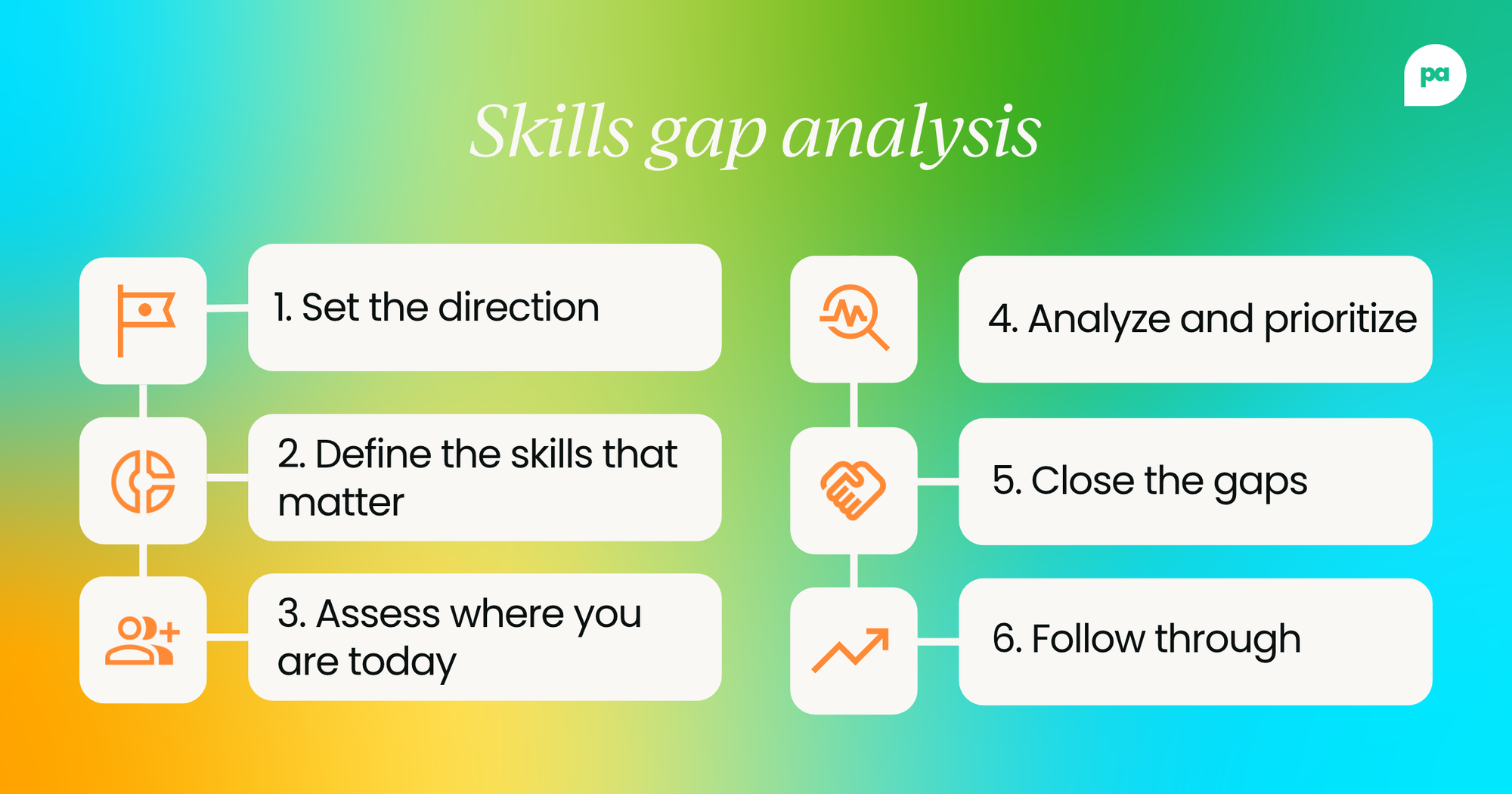
Use this checklist to keep your analysis on track from kickoff to follow-up. Work through it in order, since each phase builds on the one before.
Phase 1: Set the direction
- Pull your business goals for the next one to three years and list the initiatives they depend on.
- Agree on a scope: one team, one department, or the whole organization.
- Secure an executive sponsor who’ll champion the work and act on the results.
- Bring business leaders in early so they help define what “good” looks like.
- Decide how you’ll explain the purpose to employees, and frame it around their growth.
Phase 2: Define the skills that matter
- Build or adapt a skills framework for each role or job family in scope.
- Keep it focused, ideally 15 to 25 skills per job family.
- Include technical skills, human skills like communication and leadership, and emerging skills like AI literacy.
- Write clear descriptions of each proficiency level so ratings mean the same thing to everyone.
- Flag the skills your strategy will need in the future, as well as the ones roles need today.
Phase 3: Assess where you are today
- Run employee self-assessments.
- Collect manager ratings for the same skills.
- Add evidence such as performance data, certifications, project history, or practical tests.
- Compare self-ratings with manager ratings to spot perception gaps.
- Note single points of failure, where critical knowledge sits with one person.
Phase 4: Analyze and prioritize
- Calculate the gap for each skill by subtracting current proficiency from required proficiency.
- Rank gaps by business impact and urgency.
- Group related gaps so you can tackle them together.
- Estimate the cost of leaving each high-priority gap open, such as delayed projects or overtime.
Phase 5: Close the gaps
- Choose an approach for each priority gap: build (train), buy (hire), or borrow (contract).
- Check for internal candidates with adjacent skills before opening external searches.
- Tie individual development plans to the gaps you’ve found.
- Assign an owner and a target date to every action.
Phase 6: Follow through
- Share team-level findings with employees and explain what happens next.
- Track progress against your gap scores every quarter.
- Repeat the full analysis at least once a year, and whenever strategy shifts significantly.
Common skills gap analysis mistakes to avoid
The most common misstep is treating the analysis as a one-off project. Skills change constantly, and a report that gathers dust in a shared drive helps nobody.
Build the review into your annual planning cycle so it stays alive.
A close second is running it purely top-down. If employees feel assessed rather than involved, they’ll either inflate their self-ratings or tune out entirely.
Frame the process as an investment in their careers, and follow through with real development opportunities so the effort feels worthwhile.
Another trap is focusing only on technical skills. Communication, leadership, problem-solving, and adaptability consistently rank among the skills employers say they need most.
In Chegg’s research, employers themselves ranked problem-solving and critical thinking (36%) and communication and teamwork (34%) as the most important skills for long-term success.
Leaving human skills out of your analysis gives you an incomplete map.
Last of all, watch out for analysis paralysis. You’ll never have perfect data. Start with your most strategic teams or roles, learn from that first pass, and expand from there.
A good-enough analysis acted upon beats a flawless one that never leaves the planning stage.
TL;DR
A skills gap analysis gives you the clarity to:
- Connect talent to strategy,
- Quantify the hidden cost of capability shortfalls,
- Align leaders and employees around a shared picture,
- Make smarter build-or-buy decisions, and
- Keep your best people by showing them a real path forward.
As a people leader, you’re uniquely placed to champion this work.